 how-to
Preventing Pigeon Nesting Under Solar Panels
Last Updated: October 22, 2026
Quick Summary
Preventing pigeon nesting under solar panels means blocking access to the gap beneath the array with coated bird mesh clipped around the perimeter, since scaring birds away only works temporarily. Install 3/4-inch or 1-inch mesh with metal clips every 12 to 18 inches, fastening only to the panel frame and never the roof deck.
- Pigeons return to the same ledge year after year, so blocking access matters more than scaring them off.
- Nests can clog drainage, stain panels, rot roofing, cut output, and void part of your roof warranty.
- Remove old nests in late fall or winter, when the space is empty, and never touch an active nest.
- Wear an N95 respirator, gloves, and eye protection, and dampen droppings before scraping them up.
- Bird spikes stop perching on top of panels but do nothing about nesting in the gap below.
Table of Contents
- Why Pigeons Nest Under Solar Panels
- Risks of Pigeon Nests and Droppings on Your Solar Array
- How to Inspect the Underside of Your Panels Safely
- Removing Existing Nests and Cleaning Pigeon Droppings Off Solar Panels
- Bird Mesh for Solar Panels: Step-by-Step Installation
- Step 1: Measure the perimeter and plan the layout
- Step 2: Choose mesh and clips that work together
- Step 3: Cut the mesh to length
- Step 4: Start at one corner and tuck the mesh
- Step 5: Fasten with clips every 12 to 18 inches
- Step 6: Seal the corners and edges
- Step 7: Check your work and protect the array
- Safety and warranty notes
- Pigeon Deterrents for Solar Panels: What Works and What Doesn't
- Professional Solar Panel Bird-Proofing: When to Call a Pro
- Conclusion
- Frequently Asked Questions
Why Pigeons Nest Under Solar Panels
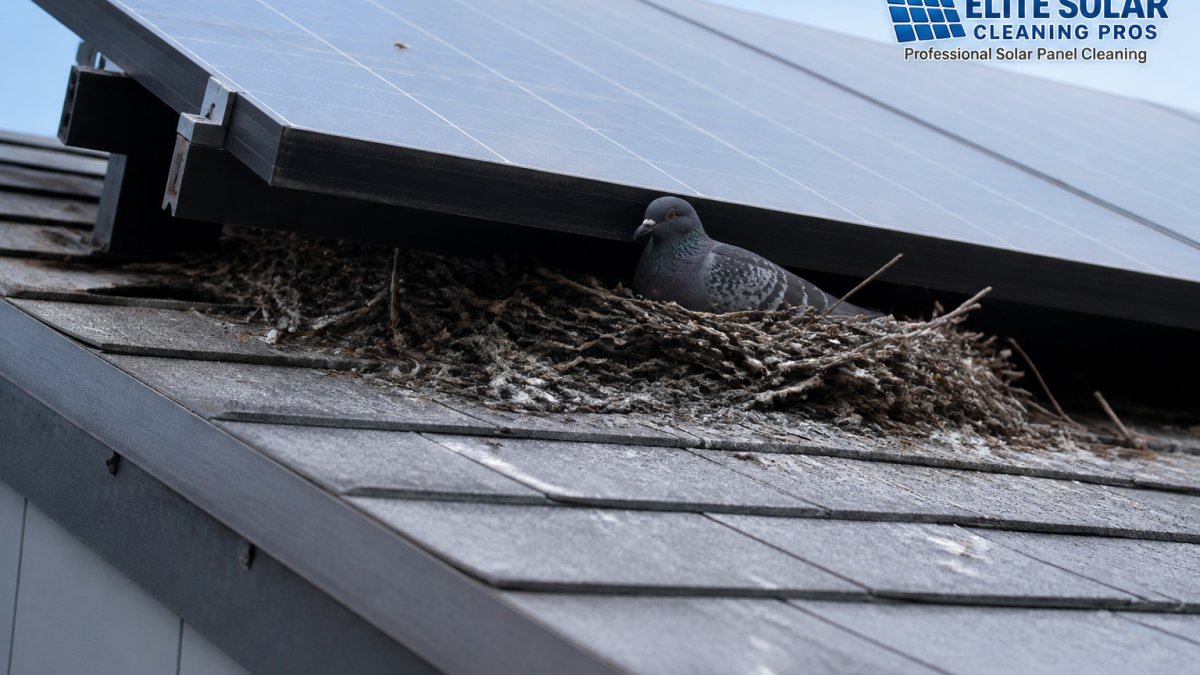
Pigeons nest under solar panels because the gap between panel and roof creates a warm, dry, protected ledge that mimics a cliff face, with shade above and shelter from wind and rain.
We see the same pattern across the area.
A few things make home solar especially attractive:
- Heat. Panels trap warm air underneath, so nests stay cozy in cool months.
- Shelter. The panel works like a roof over the nest, blocking rain and sun.
- Safety. The gap is too small for hawks and owls to reach.
Pigeon nesting is a repeat problem: once a pair claims the space, they return and their chicks learn the same spot. Blocking access matters more than scaring birds away.
Risks of Pigeon Nests and Droppings on Your Solar Array
The real cost of pigeon nesting is what the birds leave behind. Nesting material, droppings, and debris build up under the array, causing problems you can't see from the ground.
Here's what we find most often:
- Clogged drainage. Nests block the gaps that let rainwater run off, so water pools on the roof.
- Stained and damaged panels. Droppings are acidic and can etch glass and frame coatings over time.
- Roof rot. Wet nesting material holds moisture against shingles and decking.
One more thing most guides skip: a nest can void part of your roof warranty, since many roofing and solar warranties exclude pest damage.
How to Inspect the Underside of Your Panels Safely
Inspect from the ground first, then use binoculars from a ladder only on flat, solid ground. Never walk on a panel or step between the array and the roof edge.
Start with a simple ground check:
- Look at the roof edges. Droppings streaking down the fascia or gutter are a sign birds are using the array.
- Check the gutter line. Nesting material and feathers collect where runoff exits.
- Watch at dawn or dusk. Pigeons fly in and out at feeding times, so you'll spot the traffic.
- Listen. Cooing under the array is easy to hear on a quiet morning.
- Use binoculars. Scan the gap along the panel edges for straw, twigs, and whitewash.
If you need a closer look, hire a pro with roof access and fall protection. Solar arrays carry live DC wiring even in low light, and one wrong step on a panel can crack glass or break a connection.
Removing Existing Nests and Cleaning Pigeon Droppings Off Solar Panels
Removing nests and cleaning droppings is where homeowners most often create a legal, health, or roof-damage problem. The safe sequence: confirm the nest is inactive, protect yourself, remove debris without forcing water or dust into the array, and dispose of it properly. If any step is uncertain, call a professional.
Confirm the nest is inactive before you touch it
Under the Migratory Bird Treaty Act, active nests with eggs or young birds are protected, and removing them can carry legal consequences.
Nesting peaks from early spring through late summer, with some pairs nesting year-round in warm, sheltered spots.
If an active nest must go for safety reasons, contact a licensed wildlife-control professional or your state wildlife agency.
Protect yourself before you start
Dry pigeon droppings can carry bacteria and fungi that become airborne when disturbed. Before you touch anything:
- Wear an N95 respirator or better, not a dust mask, a cloth mask does not filter fine dust.
- Wear gloves and eye protection. Disposable nitrile gloves are fine; wash your hands after removal.
- Dampen droppings lightly with a spray bottle before scraping. Wet dust stays down; dry dust goes into your lungs.
Remove and dispose of debris correctly
Work from the outer edge inward, and never step on a panel or between the array and the roof edge. Use a plastic scraper or soft brush, not metal tools that scratch glass or frame coatings.
After the debris is gone, wash the panel glass and frames with plain water and a soft brush, skip harsh chemicals and abrasives that stain frames or etch glass.
When to call a professional
Call a pro if the nest is active, droppings are heavy or accumulated over multiple seasons, the roof is steep or fragile, or you see chewed wiring or stained decking. A qualified wildlife-control or solar-maintenance professional can confirm removal is lawful, clean up with proper PPE, and document the work for warranty purposes. Cleaning pigeon droppings off solar panels is not a job to improvise when health or roof damage is a concern.
Bird Mesh for Solar Panels: Step-by-Step Installation
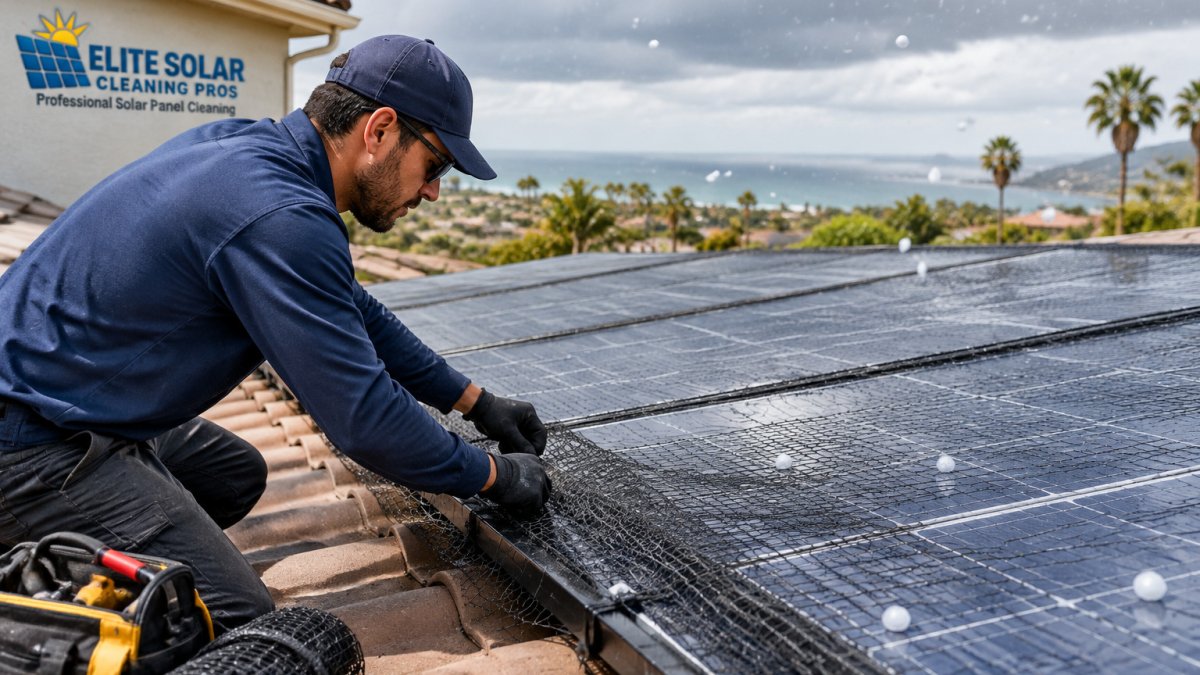
Bird mesh for solar panels is a coated wire barrier clipped around the array's perimeter to block access to the gap underneath. It's the most reliable fix, and a careful DIY job can work on a simple roof.
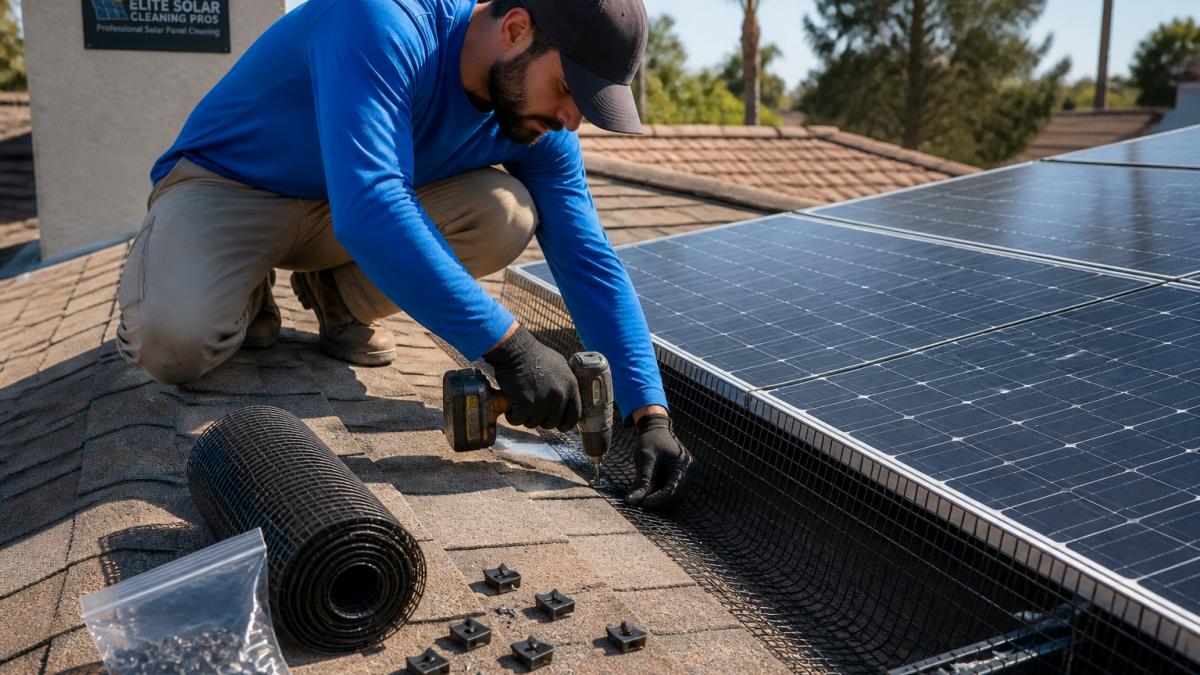
Total time: 2-4 hours for a typical home array Difficulty: Moderate (roof access required)
What you'll need:
- Black PVC-coated bird mesh with 3/4-inch or 1-inch openings. Smaller openings block sparrows; 1-inch is usually enough for pigeons.
- Solar panel mesh clips or self-tapping fasteners with washers rated for outdoor use
- Tin snips or wire cutters
Step 1: Measure the perimeter and plan the layout
Run a tape along every exposed edge of the array, including the sides and bottom edge along the roof, and add 10% for overlap and trimming. Sketch the array so you know where corners and seams fall. Measure the panel-to-roof gap at several points; the mesh must span it without pulling tight against the roof.
Step 2: Choose mesh and clips that work together
Mesh opening size matters: 3/4-inch coated mesh keeps out pigeons and most small birds, while 1-inch mesh is easier to work with and still blocks pigeons. Match the clip to the panel frame thickness and wire diameter. Cheap plastic clips fail in heat and UV within a season or two; metal clips or coated outdoor-rated fasteners last for years.
Step 3: Cut the mesh to length
Cut slightly long, then trim to fit. Coated mesh cuts cleanly with tin snips; wear gloves because cut wire ends are sharp. Lay the pieces out on the ground in install order so you're not hunting for the right piece on the roof.
Step 4: Start at one corner and tuck the mesh
Tuck the mesh into the gap so it sits flush against the panel frame and the roof, with no gap wider than your thumb. Starting at a corner lets you set the alignment for the whole run.
Step 5: Fasten with clips every 12 to 18 inches
Attach mesh clips directly to the panel frame every 12 to 18 inches, closer at corners. Keep the mesh taut but not so tight it bows the frame or lifts the panel. Work around the perimeter, overlapping sections by a few inches and fastening each seam so birds can't push through.
Step 6: Seal the corners and edges
Corners are where birds push through. Fold and clip the mesh so there is no gap wider than your thumb. Check the bottom edge along the roof especially carefully, because that is the most common entry point. If the roof surface is uneven, add clips closer together to keep the mesh from sagging.
Step 7: Check your work and protect the array
Walk the ground perimeter and look for sagging or open edges; re-clip anything loose. Before leaving the roof, confirm no clip presses on wiring, no fastener pierced the roof deck, and no mesh rubs against panel glass. Photograph each edge to spot problems later and document the work for warranty questions.
Safety and warranty notes
Solar arrays carry live DC wiring even in low light, and one wrong step can crack glass or break a connection. Use fall protection, keep tools away from wiring, and don't work on a wet or windy roof. Check your installer or manufacturer warranty before drilling or clipping; some require approved fasteners or professional installation, and a DIY mistake can void coverage.
Pigeon Deterrents for Solar Panels: What Works and What Doesn't
Physical barriers work; most scare tactics don't. Pigeons are smart, adapt fast, and return to a good ledge no matter what's sitting on it.
Here's how the common pigeon deterrents for solar panels stack up:
| Deterrent | Works? | Why |
|---|---|---|
| Bird mesh | Yes | Blocks access completely |
| Bird spikes | Partly | Stops landing on top, not nesting below |
| Solar panel critter guard | Yes | Same idea as mesh, pre-cut kits |
| Ultrasonic devices | No | Birds habituate within weeks |
| Reflective tape or CDs | No | Works for days, then ignored |
| Decoys (owls, hawks) | No | Pigeons learn they don't move |
| Gel repellents | Partly | Messy, needs reapplication |
Bird spikes and wire barriers have a place, but not under the array.
The honest take: anything that relies on scaring birds is a temporary fix. Blocking access is the only method that holds.
Professional Solar Panel Bird-Proofing: When to Call a Pro
Call a pro when your roof is steep, your array is large, or birds are already established. Professional solar panel bird-proofing removes the roof risk and gets the barrier right the first time.
We recommend hiring out in these cases:
- Steep or fragile roofing. Tile, slate, and steep shingles are risky to walk.
- Two-story or taller homes. Ladder work at height needs fall protection.
- Active infestation. Nest removal and cleanup need proper gear.
A proper job includes nest removal, surface cleaning, mesh installation with metal clips, and a final inspection. Ask for proof of licensing and insurance before anyone climbs.
Conclusion
Pigeon nesting under solar panels is solvable, but only if you block access instead of chasing birds away. Inspect the array, clear inactive nests safely, clean the surfaces, and install coated bird mesh with metal clips, that combination holds for years.
If roof access, active nests, or a large array make the job risky, let a licensed team handle it. Elite Solar Cleaning Pros offers roof-safe inspection, nest and debris cleanup, and bird-proofing backed by full insurance.
Frequently Asked Questions
Is it common for pigeons to nest under solar panels?
Yes. Solar panels create a sheltered, warm gap between the panel and the roof, which pigeons find ideal for nesting. Once a pair settles in, they tend to return season after season. The space also protects nests from rain and predators, so an untreated array can host repeated infestations. Inspecting the underside of your panels every few months is the simplest way to catch nesting early and prevent it from becoming a recurring problem.
Can pigeon nests or droppings damage solar panels?
They can. Droppings are acidic and leave stubborn stains that block sunlight and reduce output. Nests and nesting material trap moisture against the roof and wiring, and debris can clog drainage. Over time, accumulated droppings and debris may also affect panel performance and could raise warranty questions if damage is traced to neglect. Regular cleaning and a physical barrier such as bird mesh for solar panels are the most reliable ways to protect your system.
Can you install bird mesh on solar panels yourself?
A confident DIYer can install bird mesh for solar panels using mesh clips and fasteners, but the job involves roof access, working around live electrical components, and fitting the mesh tightly along every panel edge. Mistakes leave gaps that pigeons exploit. If your roof is steep, your array is large, or you are unsure about safety, professional solar panel bird-proofing is the safer choice. Pros also know how to seal the perimeter without putting pressure on the panels.
How often should solar panel bird-proofing be inspected?
Check the mesh and fasteners at least twice a year, and after any strong storm. Look for sagging mesh, loose clips, and new gaps at the panel edges. Pigeon deterrents for solar panels only work if the barrier stays intact, so a quick visual inspection from the ground with binoculars can catch problems early. If you notice droppings or nesting material returning, schedule a professional inspection and cleaning before the infestation spreads.