 comparison
Industrial vs Residential Solar Cleaning: Key Differences
Quick Summary
Industrial solar cleaning serves large arrays with multi-person crews, lifts, site safety plans and detailed service logs, while residential solar cleaning is a smaller job for roughly 10 to 40 panels, typically done by one or two technicians with a water-fed pole. Pricing units also differ, so compare bids on a total-cost basis.
- Residential systems typically have roughly 10 to 40 panels; industrial systems have hundreds to thousands of modules.
- Industrial crews are multi-person with a supervisor, while residential jobs usually need one or two technicians.
- Industrial clients often need before-and-after reports and service logs tied to output data.
- Residential pricing is often a flat visit fee or per-panel rate; industrial work is often quoted per kilowatt, per site or by contract.
- Normalize every bid to total price, then divide by panel count and system kilowatts to compare fairly.
Table of Contents
- Side-by-Side Comparison of Operational Factors
- Industrial Solar Panel Cleaning Cost Compared With Residential Pricing
- Commercial Solar Panel Cleaning Frequency and Soiling Impact
- Solar Panel Cleaning Equipment Used at Each Scale
- Professional vs DIY Solar Panel Cleaning: Risk, Safety and Water Quality
- Choosing the Right Cleaning Service for Your Solar Array
- Frequently Asked Questions
How Industrial and Residential Solar Cleaning Differ
Industrial and residential solar cleaning are different services built around different systems, risks, and buyers. A rooftop array on a San Diego home might have 20 panels, while a commercial installation can span thousands of modules across warehouse roofs or ground-mount fields. For the actual San Diego cleaning rates and the factors that move the price, see Solar Panel Cleaning Cost in San Diego. That scale change affects equipment, staffing, safety planning, and pricing. Commercial differences are worth understanding before you choose a provider.
The core difference is logistics. Commercial work requires site surveys, lift or roof access planning, traffic control in some cases, and documentation for property managers who need proof of service. A property manager reviewing a 500-kilowatt system wants cleaning records tied to output data, not just a receipt.
Water quality also shifts with scale. Large systems can use similar methods, but the water volume, tank logistics, and water-use reporting become much bigger considerations. Anyone deciding between providers should ask how water is sourced, filtered, and measured.
Side-by-Side Comparison of Operational Factors
The table below compares the operational factors that most often separate a residential cleaning service from an industrial one. Use it as a starting checklist when you request quotes.
| Factor | Residential Cleaning | Industrial Cleaning |
|---|---|---|
| System size | Roughly 10 to 40 panels | Hundreds to thousands of modules |
| Typical crew | 1 to 2 technicians | Multi-person crew with a supervisor |
| Equipment | Water-fed pole, soft brush | Lifts, larger water systems, mobile tanks |
| Documentation | Service receipt | Service logs, before-and-after reports |
| Scheduling | Flexible, often one visit | Planned around operations and seasons |
| Safety planning | Roof access and fall protection | Site-specific safety plan and permits |
Neither is automatically better. The right choice depends on what you need the service to prove.
Industrial Solar Panel Cleaning Cost Compared With Residential Pricing
Pricing is where most buyers get confused, because providers quote in different units and the unit itself changes with system size. Residential pricing is usually a flat visit fee or a per-panel rate with a minimum charge. Industrial pricing is more often quoted per kilowatt, per site, or as a recurring contract, because a 500-kilowatt array cannot be priced the same way as a 20-panel roof.
To compare fairly, normalize every bid to the same unit. Ask each provider for a total price and then divide by panel count and by system kilowatts.
| Pricing unit | Residential example | Industrial example | What it hides |
|---|---|---|---|
| Per visit | $150 to $350 flat | Rarely used at scale | Panel count and system size |
| Per panel | $9.00 with $150 minimum | $2.00 plus base charge | Minimums and mobilization |
| Per kilowatt | Seldom quoted | Common on contracts | Access difficulty and water |
| Per site | Not typical | Common for carports and fields | Frequency and reporting |
Pricing depends on system size, access, and visit frequency. You can request a free quote from the team to see how your system compares.
Commercial Solar Panel Cleaning Frequency and Soiling Impact
Cleaning frequency depends on dust, pollen, bird activity, and rainfall. For a dedicated guide to choosing a schedule, see how often solar panels should be cleaned. In dry, dusty climates, soiling builds up faster than in areas with regular rain. Soiling can reduce output, and the loss grows when dirt is left through a dry season.
Soiling is not always visible from the ground. To see how much dirt can cut energy yield and what that means in dollars, read how dirty solar panels affect output. A thin film of dust can reduce output without leaving obvious streaks, which is why monitoring data matters. Commercial operators should compare production against expected output during dry periods and schedule cleaning when the gap widens. Property managers who need documented service can review commercial solar panel cleaning in San Diego. Residential owners can check their inverter app for a similar pattern.
Leaves, bird droppings, and debris can cause localized shading, which affects output more than an even layer of dust. Remove heavy debris promptly, but avoid scrubbing hard surfaces, since abrasion can damage anti-reflective coatings.
Solar Panel Cleaning Equipment Used at Each Scale
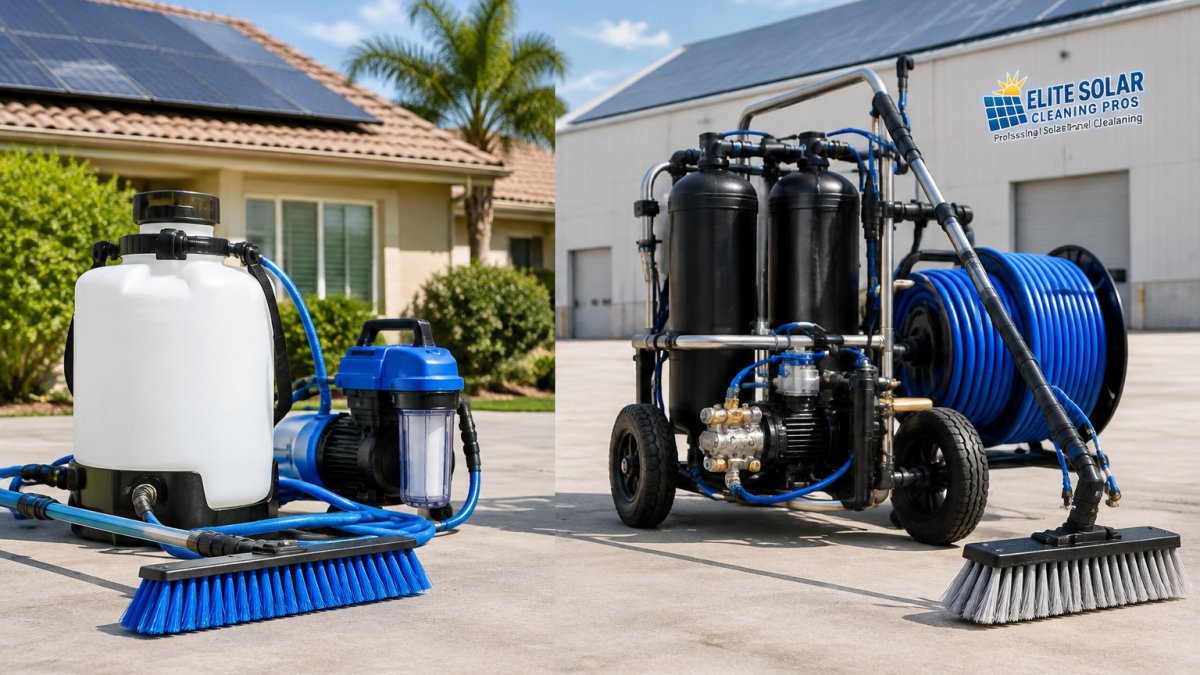
Equipment is the clearest physical difference between residential and industrial cleaning, and the choice of method should follow the installation, not the other way around. Most practitioners group tools into four tiers: manual poles and brushes, water-fed pole systems, robotic cleaners, and fixed automated systems. Each tier fits a different scale and access pattern.
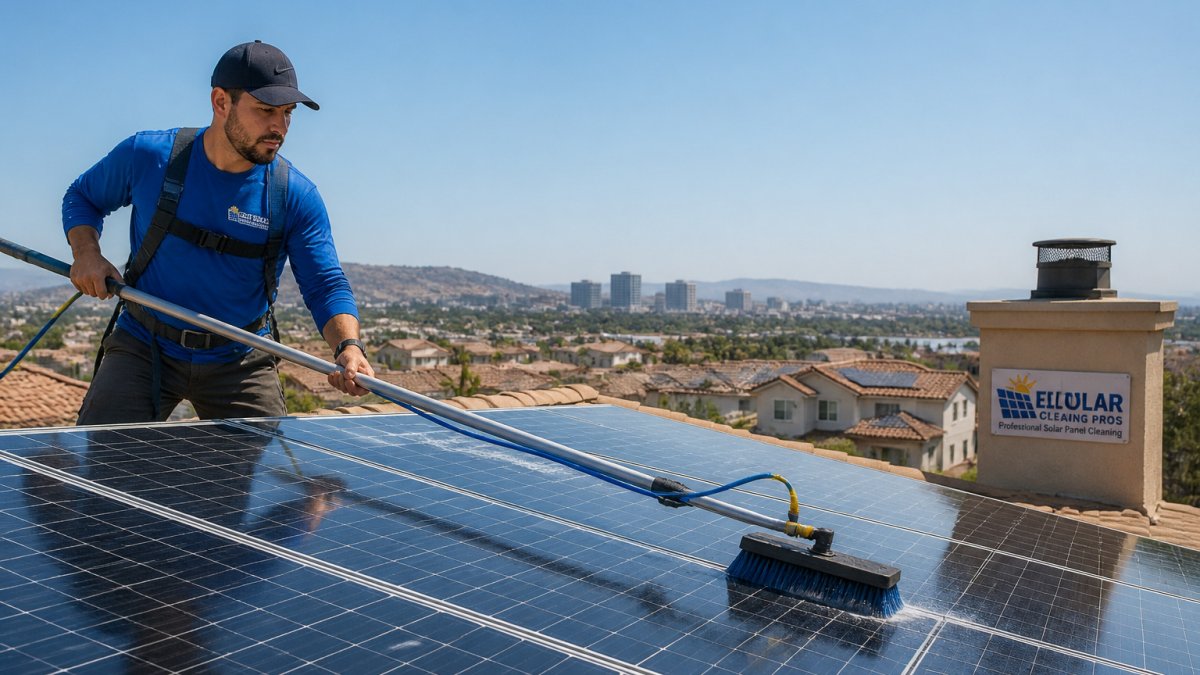
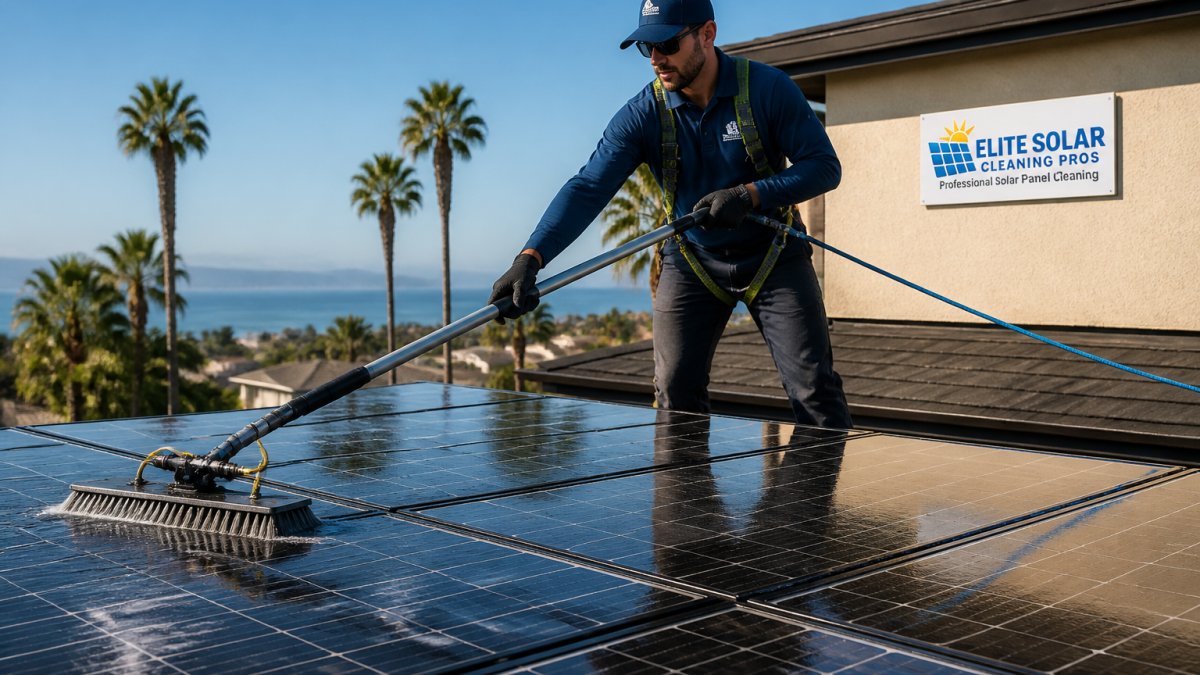
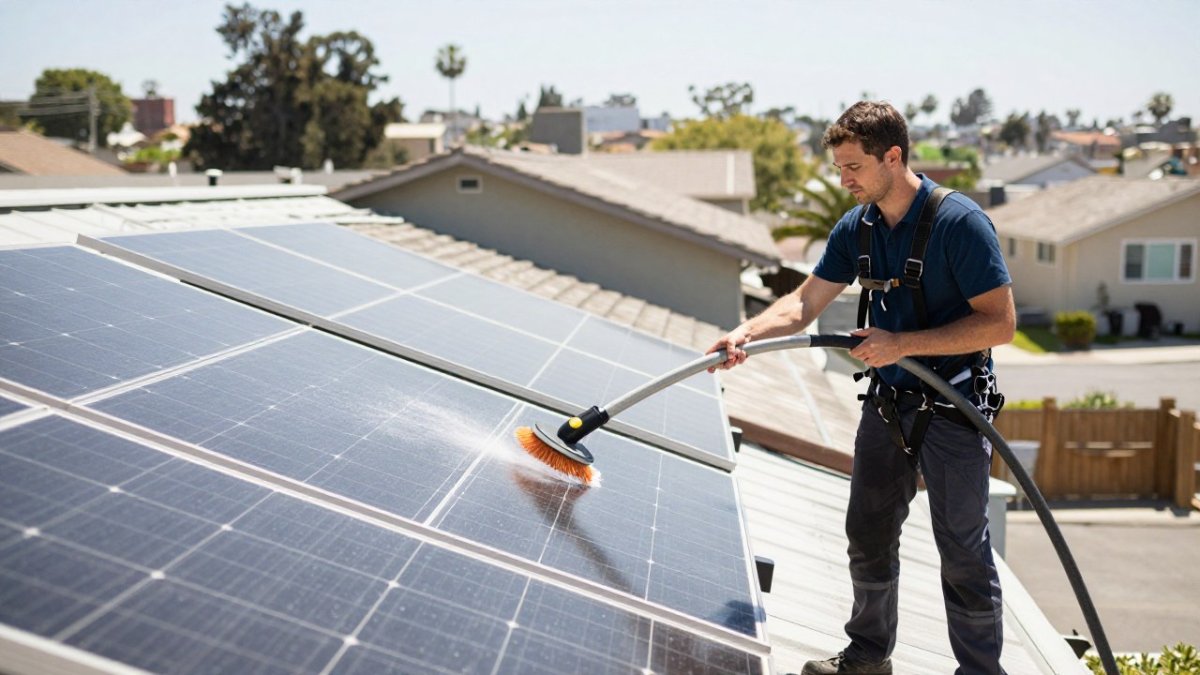
Residential cleaning can be done with a water-fed pole and deionized water.
The table below compares where each method is practical.
| Method | Best fit | Main limitation |
|---|---|---|
| Manual pole and brush | Small residential roofs | Limited reach and speed |
| Water-fed pole with deionized water | Residential and light commercial | Water volume and refills at scale |
| Robotic cleaner | Large uniform arrays | Obstructions and row spacing |
| Fixed automated system | Utility and industrial sites | Plumbing, drainage, upkeep |
Ask any provider what equipment they use, how water is filtered, and whether their methods are compatible with your panel warranty. On industrial sites, also ask how they move water between rows and whether robotic or automated methods are part of the quote.
Professional vs DIY Solar Panel Cleaning: Risk, Safety and Water Quality
DIY cleaning looks cheap, but the risks add up. Working on a roof involves fall hazards, and hauling water or ladders can cause injuries. Hard water left on panels leaves mineral deposits that reduce output over time. Scrubbing with household cleaners or abrasive pads can scratch glass and damage coatings.
Licensed and insured service matters most when something goes wrong during cleaning. Confirm that the provider's liability coverage applies to your roof and panels, and ask what happens if a panel is damaged during the visit.
Electrical safety also matters. Panels are energized when the sun is up, and technicians should avoid wet connectors and damaged wiring. If you spot a cracked panel, a burned connector, or a loose wire, stop cleaning and call a qualified installer.
Choosing the Right Cleaning Service for Your Solar Array
Start by matching the provider to your system. A homeowner with a rooftop array should look for a provider that offers water-fed pole cleaning, clear per-visit pricing, and proof of insurance. A property manager or business owner with a larger system should ask for site-specific safety plans, service logs, and references from similar properties.
Compare providers on four points: total cost for your panel count, water and equipment methods, insurance and safety practices, and reporting. A provider that will not explain its methods or share its insurance details is a warning sign.
If your system is in San Diego, Elite Solar Cleaning Pros offers residential solar panel cleaning using deionized water, and our team is licensed and insured. Request a free quote to see what cleaning would cost for your array and how often your panels need it.
Last Updated: November 12, 2026
Frequently Asked Questions
What is the difference between industrial and residential solar panel cleaning?
Residential and commercial solar panel cleaning differ mainly in scale, staffing and safety requirements. Both should use non-abrasive methods to protect the panels.
Does cleaning solar panels really improve their energy output?
Dust, pollen, leaves and bird droppings reduce the light reaching the cells, so soiling lowers power output. Elite Solar Cleaning Pros reports restoring up to 30% of energy output, but results depend on how dirty the panels are, the local weather and the system's condition. Comparing monthly production before and after cleaning, using your inverter or monitoring data, is the most reliable way to verify the gain.
Can homeowners clean their own solar panels safely?
Homeowners can rinse panels from the ground with a soft brush and deionized water, but roof access creates fall risk and harsh cleaners or pressure washing can damage the glass or seals. Panels are also live electrical equipment. Licensed and insured professional cleaners can be a safer choice for rooftop work.
When should a solar panel owner hire a professional cleaner?
Consider hiring a professional when panels are on a steep or multi-story roof, when the array is large or ground-mounted, when visible buildup or bird droppings persist after rain, or when monitoring shows a sustained drop in output. Professional service is also useful when a warranty or HOA requires documented maintenance.