 how-to
Why Solar Output Drops in Summer: Heat's Hidden Toll
Table of Contents
- Why Solar Output Drops in Summer: The Heat Penalty
- Solar Panel Temperature Coefficient: What It Means for Homeowners
- Solar Inverter Overheating Symptoms and De-Rating
- Voltage Rise, Safety Mechanisms, and Grid Stability
- How to Clean Solar Panels for Maximum Efficiency in Summer
- Seasonal Variance: Why Peak Sun Hours Don't Guarantee Peak Output
- Frequently Asked Questions
Last Updated: September 18, 2026
Why Solar Output Drops in Summer: The Heat Penalty
Solar panels work best in cool, bright conditions, not in extreme heat. That's why solar output drops in summer even when the sun blasts down for 14 hours a day. Heat raises a panel's internal resistance, which lowers its voltage and cuts the power it sends to your home.
This guide explains the full chain: hot panels, hot inverters, and a grid that pushes back. We'll show you exactly how to spot each problem and what to do about it.
Here's the part most homeowners miss. A panel's rated wattage comes from a lab test at a fixed temperature, not a real roof. So the nameplate number was never a promise for a July afternoon.
Ambient Temperature vs. Panel Efficiency
Panel efficiency is the share of sunlight a panel turns into usable electricity. As ambient temperature climbs, that share falls.
Most panels lose output once cell temperatures pass roughly 25°C (77°F). On a hot roof, cells can run far above the air temperature. Dark surfaces in direct sun get very hot, and panels sit on those surfaces all day.
A few things drive how bad the loss gets:
- Air temperature at the roof, not the forecast
- Wind, which cools panels and clears heat
- Mounting height, which sets how much air moves underneath
- Soiling, because dust and grime trap heat on the glass
The U.S. Department of Energy notes that high temperatures reduce solar panel performance, which is why Department of Energy guidance on solar performance treats heat as a core design factor, not an afterthought.
Solar Panel Temperature Coefficient: What It Means for Homeowners
The temperature coefficient is the rate at which a panel's output falls for every degree the cell runs above 25°C (77°F). It's printed on every panel spec sheet, and it's the single number that tells you how much a hot day will cost you.
The coefficient is a small negative percentage per degree Celsius. A typical value sits between -0.30% and -0.45% per degree Celsius. That means a hotter-running panel with a worse coefficient loses more power on the same roof.
Here's how to read it without the math headache:
- A coefficient closer to zero is better in hot climates.
- A coefficient of -0.30% holds output better than -0.45%.
- Two panels with the same wattage can perform differently on a hot roof.
This is the gap between a spec sheet and real life. Most buyers compare wattage and stop there. The coefficient is what separates a panel that holds up in summer from one that fades.
Solar Inverter Overheating Symptoms and De-Rating
Inverter de-rating is when an inverter deliberately caps its own power output to keep its internal components below a thermal limit. It is a designed safety behavior, not a failure, but it silently trims production on the hottest afternoons of the year.
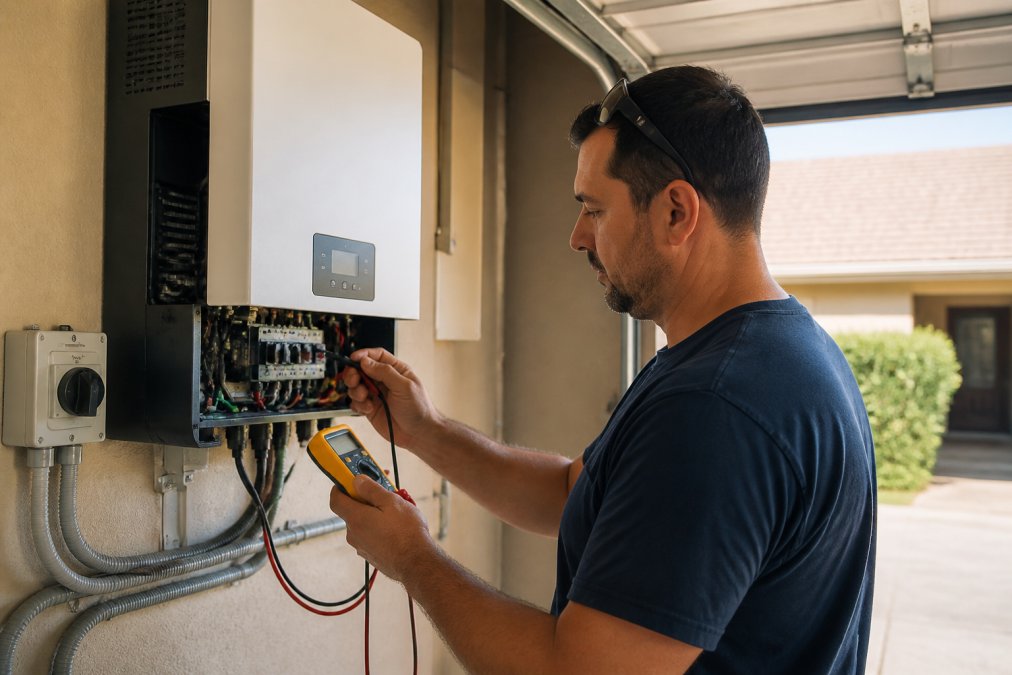
Every inverter has a rated operating temperature range and a thermal threshold, the internal temperature at which the control firmware begins folding back output.
Watch for these signs:
- Output flatlines at roughly the same time each afternoon
- The inverter chassis is hot to the touch or its fan runs continuously
- Warning or fault codes appear during peak sun and clear by evening
- The unit is mounted in direct sun, a closed garage, or an unvented closet
Why Inverter Placement Decides How Much You Lose
Manufacturers publish a maximum ambient temperature for full-power operation, and above that number the unit de-rates on a sliding scale. A wall-mounted inverter in a shaded, ventilated garage may never hit its threshold. The same unit bolted to a sun-baked exterior wall in an unvented alcove can de-rate every clear afternoon from June through August.
Practical fixes that cost little:
- Move or shade the inverter so it never sits in direct afternoon sun.
- Add cross-ventilation to the mounting space.
- Keep clearance around the unit per the installation manual.
- Confirm the unit is not stacked against insulation or stored items.
String vs. Micro-Inverter Thermal Performance
This is the comparison most guides skip, and it matters more than any single spec sheet number.
| Setup | Where It Sits | Heat Behavior | Best For |
|---|---|---|---|
| String inverter | One central unit | Whole array de-rates together if the box overheats | Shade-free roofs, lower upfront cost, easy service access |
| Micro-inverters | Under each panel | Heat spreads across many units; one failure is isolated | Partial shade, complex roofs, high-heat climates |
What Monitoring Reveals
System monitoring turns a vague suspicion into evidence. A daily production curve that clips flat on hot afternoons points directly at thermal de-rating. Log the trip times and ambient temperatures for a week, then compare against a cool, clear day. If output recovers on the cool day, the panels are fine and the inverter is the bottleneck.
Voltage Rise, Safety Mechanisms, and Grid Stability
Voltage rise is when the voltage at your inverter climbs above the grid's limit, tripping a safety shutdown. On hot days, everyone's air conditioners run at once, and the local grid gets stressed.
- The inverter shuts down mid-afternoon and restarts later
- Output drops to zero while the sun is still strong
- Neighbors with solar report the same pattern
How to Clean Solar Panels for Maximum Efficiency in Summer
Cleaning solar panels for maximum efficiency means removing the dust, pollen, and grime that block light and trap heat on the glass. Soiled glass runs hotter than clean glass, and hot glass loses output, so cleaning is a heat-management task, not just a cosmetic one.
A safe summer routine:
- Clean early morning or late evening, never in peak heat.
- Rinse with soft, low-mineral water to avoid spotting.
- Use a soft brush or water-fed pole, never abrasive pads.
- Skip harsh soaps that leave residue on the glass.
- Check for bird droppings, which shade small areas hard and create hot spots.
Roof Ventilation and Mounting Height Impact
This is the factor most cleaning guides ignore, and it often matters more than the cleaning itself.
What to check on your own roof:
- Is there a clear gap between the panel frame and the roof surface?
- Does the roof have ridge vents, soffit vents, or other airflow paths?
- Are panels packed edge to edge with no room for air to move?
- Is the array mounted on a dark, heat-absorbing surface like asphalt shingle or dark metal?
When Cleaning Is Not the Answer
If your output drops on hot afternoons even with clean panels and good airflow, the problem is almost certainly thermal, inverter de-rating, voltage rise, or simply the physics of hot cells. Cleaning helps, but it cannot overcome a panel that is already running 30°F to 50°F above ambient. Track your production curve across a cool week and a hot week before assuming grime is the culprit.
Seasonal Variance: Why Peak Sun Hours Don't Guarantee Peak Output
The National Renewable Energy Laboratory solar research studies how temperature and irradiance shape real-world photovoltaic output, and the pattern holds: heat is a steady tax on production.
A few habits protect your summer numbers:
- Compare this year's output to last year's, not to a single hot week.
- Log inverter trips and de-rating events.
- Keep panels clean and airflow clear.
- Review system monitoring monthly, not just in July.
Frequently Asked Questions
What is the 33% rule for solar panels?
The 33% rule is a general guideline that solar panels may produce about 33% less energy on a very hot day compared to their rated output. This drop comes from heat degradation, where high ambient temperatures reduce panel efficiency. The exact loss depends on your panel's temperature coefficient and the actual cell temperature, which can reach 25°C (45°F) above ambient. Monitoring your system can show if your output matches this pattern.
Does extreme heat permanently damage solar panels?
Extreme heat rarely causes permanent damage to modern solar panels, but prolonged thermal stress can accelerate wear on semiconductor properties and encapsulants. Most panels are tested to withstand high temperatures, and manufacturers set a thermal threshold for safe operation. If temperatures exceed that threshold consistently, you may see long-term degradation. Regular maintenance and system monitoring help catch issues early before they become permanent.
How much does temperature affect solar panel efficiency?
Temperature affects solar panel efficiency through the temperature coefficient, typically between -0.3% and -0.5% per degree Celsius above 25°C (77°F). For example, if a panel's coefficient is -0.4% and the cell temperature hits 45°C (113°F), you lose about 8% of output. In summer, cell temperatures can climb even higher, causing a 10-25% drop. This is why solar output drops in summer despite longer days.
What time of day are solar panels most efficient?
Solar panels are most efficient during peak sun hours, usually between 10 a.m. and 2 p.m. when solar irradiance is strongest. However, if ambient temperature is high, panel efficiency can dip even during peak sun hours because of heat degradation. In summer, early morning and late afternoon may actually yield better conversion efficiency since the panels are cooler, though total energy yield is still lower due to weaker sunlight.
Heat, dust, and grid stress all chip away at summer production, and the losses stack up fast. Elite Solar Cleaning Pros helps homeowners fight the part you can control: clean glass and clear airflow, done with eco-friendly DI water by a licensed and insured team. Our service can restore up to 30% of your energy output and help lower your monthly electric bills. Get a free quote from Elite Solar Cleaning Pros and protect your solar investment this summer.