 blog
blog
Spark Solar Cleaning vs Trident Cleaning: 2026 Guide
Table of Contents
- Spark Solar Cleaning vs Trident Cleaning: At-a-Glance Comparison
- Solar Panel Cleaning Cost: What Affects Your Quote
- How Often to Clean Solar Panels in Southern California
- Professional Solar Panel Cleaning Benefits vs DIY
- The Hidden Risks: Why Spark and Trident Quotes Can Mislead
- Warranty, Water Quality, and Regional Maintenance Schedules
- Conclusion
- Frequently Asked Questions
Last Updated: September 20, 2026
Spark Solar Cleaning vs Trident Cleaning: At-a-Glance Comparison
Solar cleaning is the practice of removing dust, pollen, bird droppings, and other debris from photovoltaic panels so they can convert sunlight at their rated capacity. When homeowners search for spark solar cleaning vs trident cleaning, they are really asking a bigger question: does the company with the lowest quote actually protect a system's long-term output? At Elite Solar Cleaning Pros, we hear that question constantly from San Diego homeowners, and the honest answer is that price alone tells you very little. A cheap quote that skips deionized water, non-abrasive equipment, or proper safety gear can cost far more down the road than it saves up front.
The table below summarizes what separates a professional-tier quote from a budget one. Use it as a checklist, not a scorecard for any single company.
| Factor | What to Look For | Why It Matters |
|---|---|---|
| Water type | Deionized or pure water | Prevents mineral deposits and calcification |
| Equipment | Soft brush, water-fed pole | Avoids micro-cracking on panel glass |
| Insurance | Licensed and insured | Covers roof or panel damage |
| Safety | Harness and fall protection | Protects workers on steep roofs |
| Warranty | Written compliance terms | Keeps your panel warranty valid |
A quote that is 40% lower almost always cuts one of these five corners. That is the pattern worth watching for.
Solar Panel Cleaning Cost: What Affects Your Quote
Solar panel cleaning cost depends on system size, roof pitch and height, access difficulty, and how much soiling has built up. There is no single fair price, and any provider who quotes a flat rate over the phone without seeing the array is guessing. The reason two quotes for the same home can differ by hundreds of dollars is that each one is really a bundle of labor, water, equipment, and risk decisions, and those decisions are where the real cost lives.
Most reputable companies price on a few variables:
- Number of panels and total array footprint
- Roof height, pitch, and whether a safety harness is required
- Level of soiling loss, from light dust to heavy bird droppings
- Water access and whether a water-fed pole can reach the array
- Travel distance and scheduling flexibility
What actually drives the number
Labor hours, not panel count, is the true unit of cost. A single-story ranch with 16 panels on a shallow pitch might take one technician under an hour. A two-story home with 30 panels, a steep pitch, and a tile roof can take two technicians most of a morning because every panel must be reached safely from a harness or a water-fed pole. When a quote is unusually low, the most common explanation is that the provider is estimating labor hours from the panel count alone.
Water sourcing is a hidden line item. Deionized water is not free. A provider either hauls it in a tank, runs it through a portable resin system on site, or uses a water-fed pole fed by a filtration cart. Each of those adds equipment and time. A quote that does not mention water type is usually a quote that assumes a garden hose.
Access and safety add real cost. Harnesses, anchor points, roof jacks, and fall-protection training are not optional on steep or tall roofs. A provider who skips them is not cheaper because they are efficient, they are cheaper because they are carrying risk you will inherit if something goes wrong.
Soiling severity changes the pass count. Light dust may need one pass. Heavy bird droppings, pollen caked after a rain, or construction dust often need a pre-soak, a soft-brush pass, and a spot-free rinse. That is two to three times the labor of a routine clean.
How to read a quote line by line
A comparable quote should state, at minimum:
- Panel count and array footprint
- Water type (deionized, reverse-osmosis, or tap)
- Cleaning method (water-fed pole, soft brush, or both)
- Safety equipment used
- Whether debris removal and a spot-free rinse are included
- Insurance and licensing confirmation
If any of those six items is missing, the quote is not comparable to one that includes them, even if the bottom-line number looks lower. A quote that excludes debris removal or a spot-free rinse is not comparable to one that includes them.
For a typical home system, expect a range rather than a fixed number, and ask what is included. Elite Solar Cleaning Pros provides free quotes.
How Often to Clean Solar Panels in Southern California
How often to clean solar panels in this region is usually once or twice a year, but the right schedule depends on where you live. Homes near trees or open fields battle bird droppings and leaf litter.
A practical rule of thumb:
- Homes under trees or near farmland: every 3 to 4 months
Production monitoring is your best signal.
Professional Solar Panel Cleaning Benefits vs DIY
Professional solar panel cleaning benefits come down to safety, results, and warranty protection. DIY cleaning with a garden hose and dish soap often leaves surface residue that bakes on and causes mineral buildup. Worse, it can void a panel manufacturer's warranty if improper methods cause damage.
- Water quality: Deionized water dries spot-free and leaves no mineral deposits.
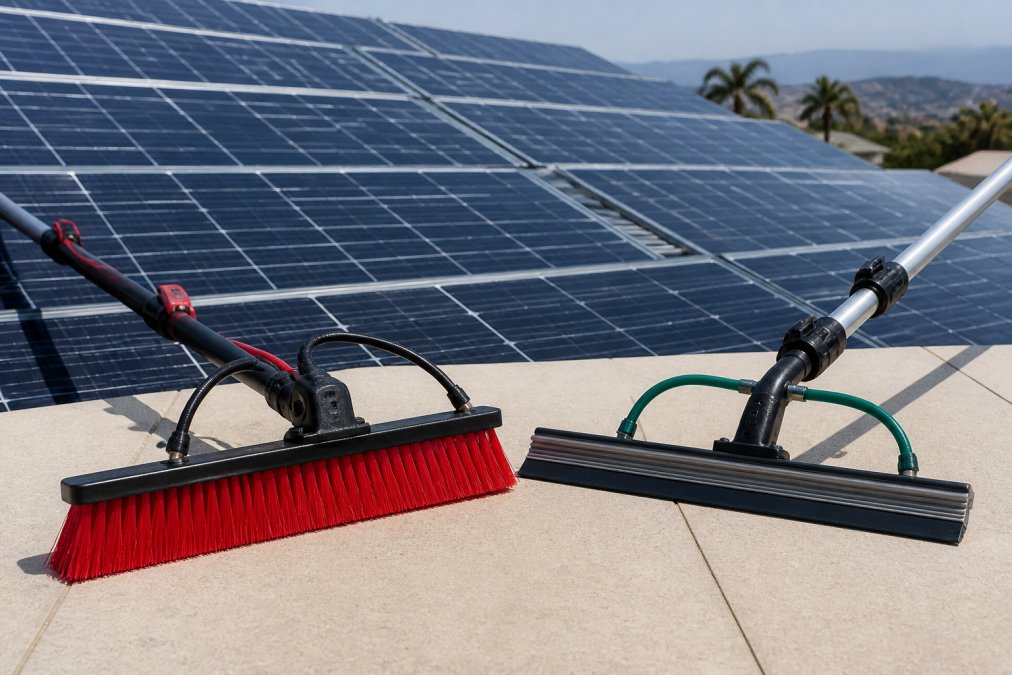
- Equipment: Soft brushes and water-fed poles clean without scratching or micro-cracking.
- Safety: Trained crews use harnesses and fall protection on rooftops.
- Warranty compliance: Documented methods keep your coverage intact.
The Hidden Risks: Why Spark and Trident Quotes Can Mislead
The biggest risk with any low quote is what it leaves out. A provider may skip deionized water, use abrasive tools, or send workers onto a roof without fall protection. These shortcuts are invisible in the price but show up later as micro-cracking, mineral deposits, or panel degradation.
Warranty, Water Quality, and Regional Maintenance Schedules
Warranty compliance, water chemistry, and climate-specific scheduling are factors that determine whether a cleaning program protects your system or quietly shortens its life.
Warranty implications of DIY cleaning
Most panel manufacturers require "reasonable and customary maintenance" and explicitly prohibit abrasive cleaning, harsh chemicals, and high-pressure washing. The exact wording varies by manufacturer, but the pattern is consistent: damage caused by improper cleaning is excluded from coverage. That means a DIY mishap, a scratched anti-reflective coating, a cracked junction box seal, or hard-water etching on the glass, can result in a denied claim, leaving you to pay for replacement modules out of pocket.
Water quality and mineral buildup
Tap water carries dissolved calcium, magnesium, and silica. When it evaporates off hot panel glass, those minerals stay behind as a thin film. One rinse leaves a faint haze. Months of rinses build a calcified layer that blocks sunlight and is difficult to remove without polishing, which itself risks the coating.
Regional climate-specific maintenance schedules
The right interval depends on what is landing on your panels and how often.
- Coastal salt spray and marine layer: Salt residue and damp marine air leave a film that holds dust. Every 6 to 8 months is typical, with an extra clean after any storm that pushes salt inland.
- Desert and inland dust: Fine dust accumulates fast and is easily baked on by afternoon heat. Every 4 to 6 months, and more often during windy seasons.
- Agricultural and tree-heavy areas: Pollen, leaf litter, and bird droppings are the dominant soiling. Every 3 to 4 months, and immediately after heavy pollen season.
- Urban and freeway-adjacent: Diesel soot and brake dust create a dark film that is easy to overlook because it looks uniform. Every 4 to 6 months.
- Snow and freeze climates: Cleaning is usually limited to the snow-free months, but spring cleaning matters more because winter grime concentrates as snow melts.
Conclusion
Comparing quotes on price alone is the fastest way to lose money on solar maintenance. What actually protects your investment is the method behind the quote: pure water, soft tools, proper insurance, and a schedule matched to your location.
Frequently Asked Questions
What is the best solar panel cleaning system for homes in San Diego?
The best systems use deionized (DI) water and a water-fed pole with a soft brush. DI water dries spot-free, so it avoids mineral deposits that can cloud glass. Look for providers that use non-abrasive equipment, follow electrical safety rules, and carry licensing and insurance. A system that combines pure water technology with a spot-free rinse protects photovoltaic efficiency and keeps your warranty intact.
Does professional solar cleaning improve energy output?
Yes. Dust, pollen, and bird droppings cause soiling loss that reduces energy output. Professional cleaning with DI water and a soft brush removes debris without micro-cracking. Elite Solar Cleaning Pros reports restoring up to 30% of energy output, which can lower electric bills. Regular preventative maintenance also supports system performance and return on investment.
How often should solar panels be cleaned in this region?
Factors include nearby trees, dust, and pollen accumulation. If you notice a drop in production monitoring or visible surface residue, schedule a cleaning.
What is the difference between DIY cleaning and a professional service?
DIY cleaning often uses tap water and household tools, which can leave mineral deposits and scratch glass. Professional services use deionized water, non-abrasive equipment, and safety harnesses for rooftop maintenance. They also carry insurance and follow fall protection rules. DIY may void warranty compliance if damage occurs. A professional service ensures warranty compliance and safe debris removal.