 blog
blog
Solar Panel Cleaning Services San Diego: 2026 Guide
Table of Contents
- Why San Diego Solar Owners Book Professional Solar Panel Cleaning
- Solar Panel Cleaning Cost in San Diego: What Drives Your Quote
- How Often to Clean Solar Panels in San Diego's Climate
- The Benefits of DI Water Solar Cleaning vs. Pressure Washing
- DIY vs. Professional Solar Panel Cleaning: Risk Assessment
- Bird Proofing, Thermal Imaging, and Preventative Maintenance
- Calculating Your ROI: Soiling Loss, Energy Efficiency, and Curb Appeal
- Frequently Asked Questions
Last Updated: September 14, 2026
Why San Diego Solar Owners Book Professional Solar Panel Cleaning
Solar panel cleaning services in San Diego exist because this region punishes photovoltaic modules in ways most owners never anticipate. Coastal salt air, inland dust, spring pollen, and months without meaningful rain coat panel glass with a film that quietly strangles energy production. At Elite Solar Cleaning Pros, we see arrays lose output to soiling long before homeowners notice.
Soiling loss is the reduction in a solar array's energy production caused by dirt, dust, pollen, bird droppings, and other contaminants accumulating on panel glass and blocking sunlight from reaching the cells underneath.
Soiling is invisible from the ground: a panel that looks "pretty clean" can still carry a film of dust and salt that reduces kilowatt-hour output daily.
How Dust, Pollen, and Salt Air Cut Your Kilowatt-Hour Output
Each contaminant attacks performance differently. Inland dust settles as a fine, even layer that dims light. Pollen arrives in sticky spring bursts and bonds to glass. Coastal salt air leaves a hazy residue water alone struggles to remove. Bird droppings create hot spots: shaded patches that force affected cells to work harder, generating heat and dragging down the whole string's output.
The U.S. Department of Energy solar energy resource pages explain how shading on even a small portion of a panel disproportionately reduces total output. That principle applies to soiling just as it does to tree shade.
Solar Panel Cleaning Cost in San Diego: What Drives Your Quote
Solar panel cleaning cost depends on system size, roof accessibility, soiling severity, and how many arrays a property has, not a flat per-panel rate. Because Elite Solar Cleaning Pros prices each job individually, the honest answer starts with a free service estimate.
Residential solar quotes typically reflect a single rooftop array with straightforward access. Commercial solar pricing reflects square footage, multiple roof sections, and reporting requirements that residential jobs don't carry.
Residential vs. Commercial Solar Array Pricing Factors
Several variables move a quote up or down:
- System size: More photovoltaic modules means more time, water, and labor.
- Roof accessibility: Steep pitches, multi-story homes, and tight setbacks require more safety setup.
- Local climate exposure: Properties closer to the coast or under heavy tree cover accumulate soiling faster and may need more thorough first-time cleaning.
- Frequency: A recurring maintenance schedule costs less per visit than one-off deep cleans after years of neglect.
A common mistake is comparing quotes on price alone. Two providers can quote the same array, but one may use a water-fed pole with deionized water while the other plans to pressure wash. Those are not the same service, and results diverge within months.
How Often to Clean Solar Panels in San Diego's Climate
Most arrays here benefit from cleaning two to four times per year, but that range is a starting point, not a schedule. The right cadence depends on your roof's microclimate, and the region has several distinct ones.
The Marine Layer and Salt Buildup Cycle
Coastal neighborhoods from the beaches inland to about five miles sit under the marine layer for much of late spring and early summer. That overnight and morning moisture condenses on panel glass, then evaporates and leaves behind dissolved salts and minerals, building a thin, hazy film continuously.
A common pattern practitioners describe: a coastal array that looks clean from the ground can still be down several percentage points in output after two to three months without rain. Because the marine layer delivers moisture but not enough volume to rinse the glass, the salt film accumulates until someone washes it off. Coastal properties typically land at the high end of the frequency range; those within sight of the surf may need quarterly service.
Inland Dust and Seasonal Pollen Bursts
Move east of the coastal fog belt and the soiling profile flips: more airborne dust, construction particulate, and agricultural debris, but far less salt. The dominant event is spring pollen.
Pine pollen is the headline offender: it arrives in a short, intense spring window as a sticky yellow-green coating that bonds to glass rather than blowing off, and once dry a simple rinse won't remove it. Eucalyptus, palm, and flowering ornamentals add debris and pollen across a broader stretch of the year.
A practical rule: if your array sits under or downwind of mature trees, treat pollen season as a mandatory cleaning trigger, not an optional one.
Rain, Drought, and Why 'It Rains Here' Isn't a Plan
The region's rainfall is concentrated in a few winter months, and the rest of the year is effectively dry. Rain is the only free cleaning most arrays ever get, and it's inconsistent at best.
Light rain can actually make things worse: a brief shower doesn't carry enough volume to rinse the glass, it just mobilizes dust and pollen and then dries, leaving a spotted, streaky residue harder to remove than the original layer. A heavy, sustained storm does a better job, but you can't schedule around one.
A Simple Decision Framework
Rather than counting months, use these triggers:
- Visible film or streaking on the glass from ground level.
- A gradual production decline in your monitoring app with no equipment fault code.
- End of pollen season for tree-adjacent properties.
- After any long dry stretch in coastal or dusty areas.
- Before peak production months, so the array runs clean when it matters most.
If two or more triggers are active, book a cleaning. If none are, you can likely wait.
The Benefits of DI Water Solar Cleaning vs. Pressure Washing
Deionized water cleaning outperforms pressure washing on solar arrays because it lifts dirt without abrasion and dries without leaving mineral deposits. DI water has had its dissolved minerals removed, so when it evaporates it leaves nothing behind. No water spots. No mineral deposits. No residue that attracts the next layer of dust.
Pressure washing, by contrast, forces water into panel frames and seal edges at high velocity, pushing moisture past seals, while minerals in ordinary tap water dry onto the glass as spotting. Over repeated washes, that spotting etches the surface and reduces light transmission.
How Deionized Water Prevents Water Spots and Micro-Cracks
Micro-cracks are hairline fractures in solar cells or glass that can develop from physical stress, thermal cycling, or improper handling and cleaning methods.
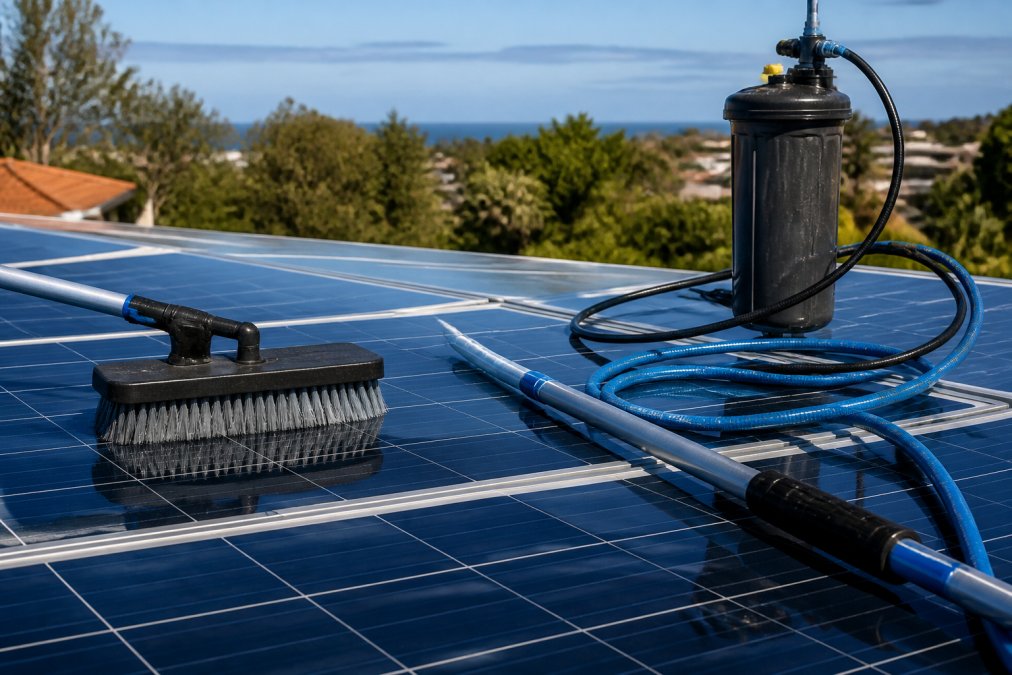
The soft wash approach matters here. A non-abrasive brush paired with DI water removes debris without the surface stress that high-pressure or abrasive methods introduce. This is also where warranty compliance enters the picture: many panel manufacturers specify cleaning methods in their warranty terms, and pressure washing can void coverage if it damages seals or coatings. Check your panel documentation before letting anyone near your array with a pressure washer.
DIY vs. Professional Solar Panel Cleaning: Risk Assessment
DIY cleaning looks simple until you're on the roof. The real risk isn't the scrubbing; it's the access, the equipment, and what happens if something goes wrong. Professional cleaning exists partly because roof safety on a solar installation is genuinely hazardous.
Here's how the two approaches compare:
| Factor | DIY Cleaning | Professional Cleaning |
|---|---|---|
| Roof safety | Homeowner risk, no harness | Safety harness, trained crew |
| Water quality | Tap water, leaves spots | Deionized water, spot-free |
| Method | Often pressure washing | Soft wash, non-abrasive brush |
| Warranty risk | High if damage occurs | Licensed, insured, compliant |
| Liability | Homeowner's insurance | Provider's coverage |
| Results | Inconsistent | Verified, repeatable |
Roof Safety, Safety Harness, and Warranty Compliance
Falls from residential roofs send thousands of Americans to emergency rooms every year, according to U.S. Consumer Product Safety Commission data on ladder and roof falls. Solar arrays add new hazards: slick glass, hidden wiring, and trip points across the roof plane. A professional crew arrives with a safety harness, proper anchoring, and the training to move across a solar array without damaging it or themselves.
The warranty angle is equally practical: if a homeowner scratches a panel or cracks a cell while cleaning, the repair comes out of pocket and the manufacturer may decline a future claim. A licensed and insured provider carries the liability instead.
Bird Proofing, Thermal Imaging, and Preventative Maintenance
Cleaning is the most visible part of solar care, but it works best alongside bird proofing and thermal imaging. Birds nesting under panels create persistent soiling and can chew wiring; critter guard mesh blocks access without blocking airflow. Thermal imaging reveals hot spots, failing cells, and connection problems invisible to the eye.
Preventative maintenance ties these together into a maintenance schedule: clean, inspect, verify, and repeat. For commercial solar and HOA-managed arrays, that routine also supports system performance reporting to stakeholders.
What most guides miss is that cleaning visits are the ideal moment for inspection. A crew already on the roof can spot cracked glass, loose mounting hardware, and debris accumulation around the array edge before they become expensive problems. The National Renewable Energy Laboratory's solar research resources document how small, undetected issues compound into larger performance losses over a system's life.
Calculating Your ROI: Soiling Loss, Energy Efficiency, and Curb Appeal
The return on professional cleaning comes from three places: recovered energy production, protected equipment life, and appearance. The first is the one you can put numbers to, and it convinces most homeowners to stop putting it off.
A Framework You Can Run Yourself
You don't need a spreadsheet to get a useful estimate. You need three inputs:
- Your system's rated output in kilowatts, from your panel documentation or installer paperwork.
- Your recent production in kilowatt-hours, from your inverter monitoring app.
- Your utility rate per kilowatt-hour, from your most recent electric bill.
The mechanism is straightforward. Soiling reduces the light reaching the cells, which reduces kilowatt-hour output, which reduces the value of what your system produces. If your array is producing less than it did in comparable conditions a year ago, and there's no equipment fault, soiling is a leading suspect.
A common pattern practitioners describe: a heavily soiled array can lose a meaningful share of its output, and the loss compounds the longer the film sits. The exact percentage depends on how much has accumulated and how long it's been there, which is why a first-time deep clean on a neglected array often produces a more dramatic recovery than routine maintenance on a well-kept one.
Turning Recovered Output Into Dollars
Once you have a sense of how much production you're missing, the math is simple:
- Estimate the kilowatt-hours you're losing per month.
- Multiply by your utility rate.
- Compare that monthly figure against the cost of a cleaning.
For many residential systems, the recovered value over a season can approach or exceed the cost of a single professional cleaning, particularly at higher utility rates. The precise break-even depends on your system size, rate, and soiling severity, but the framework lets you judge whether a quote makes sense rather than accepting a generic pitch.
The Warranty Angle Most Guides Skip
There's a second, less obvious return: protecting your coverage. Many panel manufacturers specify acceptable cleaning methods in their warranty terms, and improper cleaning can void coverage on affected modules. If a homeowner pressure washes an array, forces water past frame seals, or scratches the glass, the repair comes out of pocket and a future claim may be denied.
That risk is real money. A single damaged module can cost more to replace than years of professional cleaning, and the labor to access and swap a rooftop panel adds to it. Framing cleaning as warranty protection, not just performance maintenance, changes the calculation for anyone weighing DIY against a service.
Curb Appeal and HOA Considerations
For arrays visible from the street, appearance is a real but harder-to-quantify benefit. Streaked, spotted panels undercut the look of an otherwise well-kept home, and HOA boards increasingly factor visible solar condition into community standards. If you're in an HOA-managed community, check whether your board has guidelines on panel appearance; a clean array is the simplest way to stay compliant.
Frequently Asked Questions
Is it worth it to have solar panels cleaned?
Yes, for most San Diego systems. Dust, pollen accumulation, and salt air create soiling loss that reduces kilowatt-hour output, and professional solar panel cleaning can restore a meaningful share of that production. Elite Solar Cleaning Pros reports restoring up to 30% of energy output on heavily soiled arrays. If your inverter monitoring shows a steady decline that does not match weather patterns, cleaning is usually the cheapest fix before considering more expensive diagnostics.
How often should I wash solar panels in San Diego?
Most San Diego homes do well with cleaning every 6 to 12 months. Coastal properties dealing with salt air corrosion and heavy pollen may need service every 4 to 6 months, while inland areas with less dust can stretch to once a year. Rain helps but does not replace cleaning, because mineral deposits and bird droppings stick to the glass. Check inverter monitoring monthly and book service when output drops noticeably.
Do solar panels need to be professionally cleaned?
Not always, but the risk assessment usually favors hiring a pro. Professional crews use non-abrasive brushes, deionized water, and a safety harness to work on roofs safely. DIY cleaning with pressure washing can force water behind the seals, void warranty compliance, and leave water spots. If your array is ground-mounted and easily reachable, DIY is reasonable. For steep rooftops or commercial solar arrays, professional service protects both your panels and your roof.
What methods do professional solar cleaners use to avoid damage?
Reputable providers use a soft wash approach with deionized water and non-abrasive brushes on water-fed poles. DI water dries without leaving mineral deposits or water spots, which is important for maintaining energy efficiency. Crews also perform module inspection for micro-cracks and use thermal imaging to spot hot spots. Roof safety matters too: licensed and insured teams follow fall-protection rules and document conditions before and after service.
Solar owners face a quiet problem: production slips month by month, and nothing on the dashboard explains why. Elite Solar Cleaning Pros solves that with eco-friendly DI water cleaning, a licensed and insured crew, and service built specifically for San Diego arrays. Restore your system's output, protect your investment, and stop losing kilowatt-hours to soiling. Get your free quote from Elite Solar Cleaning Pros and put your panels back to work at full capacity.