 how-to
Does Cleaning Solar Panels Increase Efficiency?
Table of Contents
- Does Cleaning Solar Panels Actually Improve Efficiency?
- How Much Energy Production Is Lost to Dirt and Debris?
- Factors Affecting Solar Panel Soiling and Performance
- How Often Should Solar Panels Be Cleaned?
- Best Way to Clean Solar Panels at Home
- Solar Panel Cleaning Cost vs. Benefit Analysis
- Step 1: Establish Your Baseline Monthly Value
- Step 2: Estimate Your Regional Soiling Loss Rate
- Step 3: Calculate Your Monthly Loss in Dollars
- Step 4: Measure Actual Efficiency Gain After Cleaning
- Step 5: Calculate Payback Period
- Step 6: Determine Optimal Cleaning Frequency
- Real-World Scenarios
- Track Your Data Over Time
- Professional Cleaning vs. DIY: What You Need to Know
- Monitoring Your System to Measure Cleaning Impact
- Frequently Asked Questions
Last Updated: September 23, 2026
Does Cleaning Solar Panels Actually Improve Efficiency?
Does cleaning solar panels increase efficiency? Yes. Dust, pollen, bird droppings, and environmental debris accumulate on the surface and block sunlight from reaching the photovoltaic cells underneath, reducing power output.
A thin layer of dust in a dry climate might reduce output by 2-3%, while bird droppings concentrated in one spot can cut efficiency by 15-20% in that area. The improvement from cleaning depends on your specific situation.
Cleaning solar panels increase efficiency, but the improvement varies dramatically based on location, weather patterns, and how long panels have gone uncleaned.
How Much Energy Production Is Lost to Dirt and Debris?
Energy losses from soiling typically range from 5% to 25% of annual energy output. Dry climates with infrequent rainfall see higher losses; areas with regular rain see lower losses.
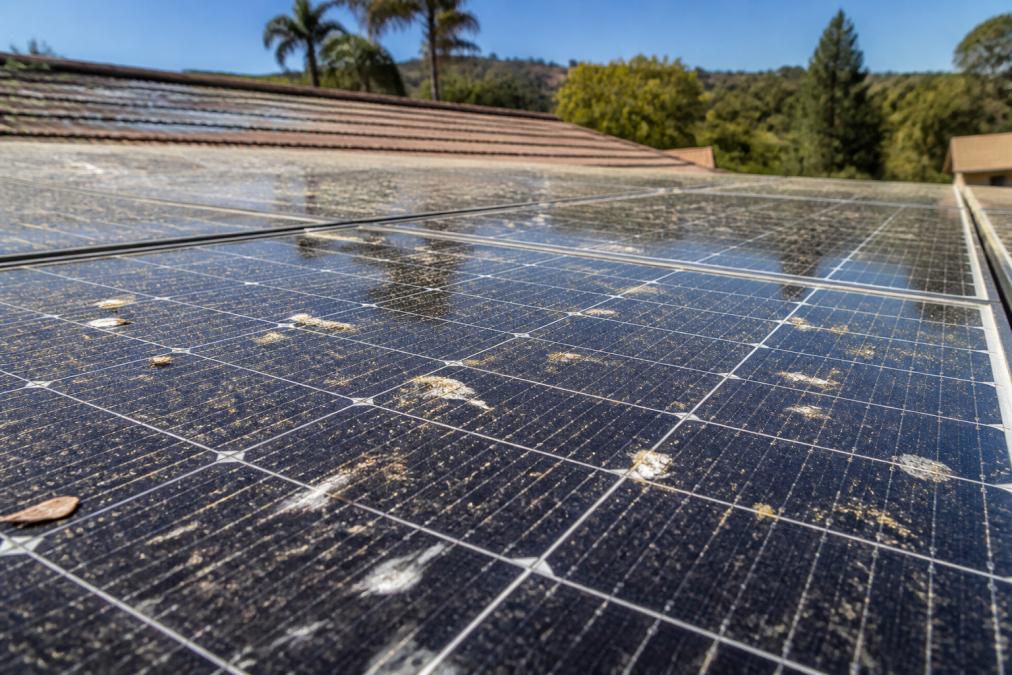
The type of debris matters significantly. Consider these common contaminants:
- Dust and sand: Fine particles that scatter light and gradually reduce output
- Pollen: Seasonal buildup that concentrates in spring and early summer
- Bird droppings: Create localized hot spots that can damage cells long-term
- Atmospheric pollution: Industrial areas see faster soiling accumulation
- Sea salt residue: Coastal properties experience accelerated degradation
A system losing 10% of energy output loses real money. If your installation generates $150 monthly, a 10% loss means $15 disappears due to dirty panels, $180 annually.
Factors Affecting Solar Panel Soiling and Performance
Not every location has the same soiling risk. Your specific environment determines how quickly panels degrade and how much cleaning helps.
Location and Climate Impact
Desert climates (Arizona, Nevada, Southern California) see dust buildup within weeks. Coastal areas experience salt spray and moisture deposits that rain alone won't remove.
Panels tilted at shallow angles (15-20 degrees) accumulate debris faster; steeper angles (35-45 degrees) self-clean better during rainfall.
Panel Tilt Angle and Weather Patterns
Coastal areas with ocean winds see faster debris movement; inland deserts accumulate dust steadily; mountain areas experience seasonal pollen surges.
The Rainfall Myth
Rainfall doesn't clean solar panels effectively. Water beads on the glass surface without washing away dust, and can concentrate mineral deposits that scatter light.
Rain removes only loose surface dust; the fine dust layer causing most efficiency loss remains.
How Often Should Solar Panels Be Cleaned?
Dry climates need cleaning every 2-4 months; coastal areas quarterly; humid regions with regular rainfall can extend to 6-month intervals.
Monitor your system's energy output monthly. A gradual decline beyond seasonal variation signals that cleaning will pay for itself.
Best Way to Clean Solar Panels at Home
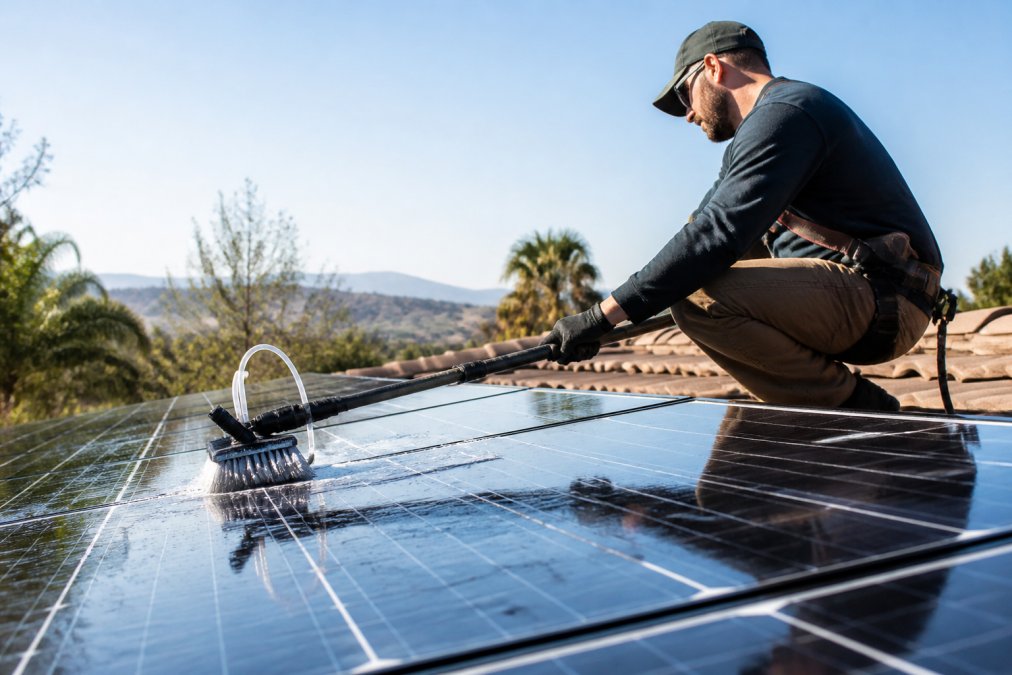
Use a sturdy ladder, secure footing, and slip-resistant shoes. If your roof pitch exceeds 30 degrees, skip DIY cleaning.
Use these steps for safe, effective cleaning:
- Turn off your system at the main breaker before starting
- Use soft water or deionized water to avoid mineral deposits
- Apply a soft-bristle brush with gentle pressure
- Rinse thoroughly with clean water
- Avoid abrasive materials that scratch the glass surface
- Work in early morning when panels are cool
Never use high-pressure washers. The force can damage seals and force water into electrical connections. Avoid harsh chemicals or soap that leaves residue.
Safety Precautions for DIY Cleaning
A safety harness is essential for roof work. Wet angled surfaces are slippery.
Turn off all breakers and wait five minutes for capacitors to discharge.
Avoiding Micro-Cracks and Panel Damage
Pouring cold water on hot glass (which can reach 160°F) creates thermal stress that cracks silicon cells.
Solar Panel Cleaning Cost vs. Benefit Analysis
The decision to clean should be data-driven, not based on industry averages. Here's a framework to calculate whether cleaning makes financial sense for your specific system.
Step 1: Establish Your Baseline Monthly Value
Find your system's typical monthly energy production in kilowatt-hours (kWh) from your inverter or utility bill. Multiply by your local electricity rate.
Step 2: Estimate Your Regional Soiling Loss Rate
High-soiling: Desert Southwest 3-4%, agricultural areas 2.5-3.5%, coastal 2-3% monthly. Moderate: Midwest 1.5-2%, Mid-Atlantic 1-1.5%, mountains 1-2% monthly. Low: Pacific Northwest 0.5-1%, frequent rainfall areas 0.5-1% monthly.
Step 3: Calculate Your Monthly Loss in Dollars
Multiply your baseline monthly value by your regional soiling loss rate.
Step 4: Measure Actual Efficiency Gain After Cleaning
Measure actual efficiency gain to confirm results.
Record inverter output on a clear day before cleaning. After 3-5 days, record output again on a similar clear day. The difference is your efficiency gain.
Step 5: Calculate Payback Period
Divide the cleaning cost by your monthly savings.
Example: $250 ÷ $10.50 = 23.8 months payback.
Step 6: Determine Optimal Cleaning Frequency
Once you know your payback period, you can decide how often to clean.
Real-World Scenarios
Scenario A: Desert System (High Soiling)
- System value: $200 monthly
- Regional loss rate: 3.5% monthly
- Monthly loss: $7 (3.5% of $200)
- Measured efficiency gain after cleaning: 15%
- Monthly savings: $30 (15% of $200)
- Cleaning cost: $250
- Payback: 8.3 months
- Recommendation: Clean quarterly. Annual cost against annual savings doesn't pencil out on paper, but the system operates at peak efficiency year-round, which extends equipment life and maintains warranty compliance.
Scenario B: Midwest System (Moderate Soiling)
- System value: $150 monthly
- Regional loss rate: 1.5% monthly
- Monthly loss: $2.25 (1.5% of $150)
- Measured efficiency gain after cleaning: 8%
- Monthly savings: $12 (8% of $150)
- Cleaning cost: $200
- Payback: 16.7 months
- Recommendation: Clean twice yearly. Annual cost against annual savings is a net loss, but cleaning maintains system performance and protects warranty coverage. Consider cleaning only annually unless output monitoring shows faster degradation.
Scenario C: Pacific Northwest System (Low Soiling)
- System value: $120 monthly
- Regional loss rate: 0.75% monthly
- Monthly loss: $0.90 (0.75% of $120)
- Measured efficiency gain after cleaning: 3%
- Monthly savings: $3.60 (3% of $120)
- Cleaning cost:
- Payback: 50 months
- Recommendation: Skip professional cleaning. Monitor output quarterly. Clean only if output drops 15%+ below baseline, which would indicate a specific problem (bird droppings, tree debris) rather than general soiling.
Track Your Data Over Time
Document every cleaning and the efficiency gain. After 2-3 cleaning cycles, you'll have real data specific to your system and location. Use that data, not industry averages, to refine your cleaning schedule.
Professional Cleaning vs. DIY: What You Need to Know
Professional services handle steep roofs, multi-level systems, and high-value installations safely. They carry insurance and use specialized equipment. DIY works for accessible single-story systems where you're comfortable on a ladder.
Why Professional Services Use DI Water
Deionized water removes minerals that tap water leaves behind. Tap water contains calcium, magnesium, and other minerals that deposit on glass as water evaporates. These deposits scatter light and reduce efficiency over time.
Warranty Compliance and Coverage
Check your panel warranty before deciding on cleaning methods. Some manufacturers specify which cleaning approaches are acceptable. Using improper methods can void coverage.
Monitoring Your System to Measure Cleaning Impact
Your inverter displays real-time energy production. Most modern systems offer app access showing daily and monthly output trends.
| Factor | Impact on Cleaning Need | Recommended Frequency |
|---|---|---|
| Desert climate, dry conditions | High soiling accumulation | Every 2-3 months |
| Coastal area with salt spray | Mineral and salt deposits | Every 3-4 months |
| Humid region with regular rain | Lower accumulation, natural rinsing | Every 6 months |
| Steep roof pitch (over 30°) | Safety concerns with DIY | Professional only |
| Ground-level accessible system | Easy DIY access | As needed, monitor output |
Frequently Asked Questions
Does cleaning solar panels really make a difference in energy output?
Yes, cleaning solar panels can significantly improve energy generation. Soiling loss, caused by dust, pollen, bird droppings, and atmospheric debris, reduces photovoltaic system efficiency by 15-25% on average, depending on your location and climate. Professional cleaning can restore much of this lost kilowatt-hour production. However, the exact improvement depends on how dirty your panels are and your local environmental conditions. Monitoring your system's inverter data before and after cleaning shows the real impact on your annual output.
How often should solar panels be cleaned for optimal performance?
Most systems benefit from cleaning 1-2 times per year, though frequency depends on your location and environment. Areas with high pollen accumulation, dust storms, or frequent bird activity may need quarterly cleaning. Conversely, regions with regular rainfall may require less frequent maintenance. The best approach is to monitor your system's energy yield monthly. If output drops noticeably below your baseline, that's a signal your panels need attention. Professional cleaning services can recommend a customized maintenance schedule based on your specific conditions.
What is the best way to clean solar panels at home safely?
If you choose to clean panels yourself, use deionized water with a soft-bristle brush to avoid micro-cracks and damage. Never use abrasive materials, harsh chemicals, or high-pressure water. Work early morning or late afternoon when panels are cool. Always use a safety harness and take fall prevention seriously, roof access requires proper equipment and precautions. Consider that professional cleaning eliminates safety risks and uses specialized techniques like DI water systems that prevent mineral deposits and streaking, ensuring optimal performance without risk to you or your investment.
Is professional solar panel cleaning worth the cost compared to DIY?
The cost-benefit analysis depends on your system size, local soiling conditions, and your risk tolerance. Professional cleaning ensures warranty compliance, eliminates safety hazards of roof access, and uses equipment that prevents micro-cracks and abrasive damage. Many homeowners find that the energy production gains can be significant. Request a free quote to compare professional service costs against your potential kilowatt-hour recovery.