 listicle
Best Eco Friendly Solar Panel Cleaner: 2026 Review
Table of Contents
- Comparison Table: Best Eco Friendly Solar Panel Cleaners
- How We Evaluated These Eco Friendly Solar Panel Cleaners
- Elite Solar Cleaning Pros: Best Overall Eco Friendly Solar Panel Cleaner
- Vinegar and Water Solution: Best Budget DIY Cleaner
- BASF Solar Cleaning Chemicals: Best for Commercial Arrays
- Water-Fed Pole System: Best for Safe Ground-Level Cleaning
- DI Water Filtration System: Best for Hard Water Areas
- pH-Neutral Solar Cleaning Soap: Best for Stubborn Grime
- Frequently Asked Questions
Last Updated: September 21, 2026
Comparison Table: Best Eco Friendly Solar Panel Cleaners
The best eco friendly solar panel cleaner depends on your array size, water hardness, and willingness to climb a ladder. This guide from Elite Solar Cleaning Pros breaks down seven options, from a $5 vinegar mix to commercial-grade systems.
| Cleaner | Starting Price | Best For | Key Feature |
|---|---|---|---|
| Elite Solar Cleaning Pros | Free quote | Most homeowners | DI water, licensed and insured |
| Vinegar and Water | Under $5 | Light dust, DIY | 1:8 white vinegar ratio |
| BASF Solar Chemicals | Contact for pricing | Commercial arrays | Residue-free formulation |
| Water-Fed Pole System | $100+ | Ground-level DIY | Soft-bristle reach |
| DI Water Filtration | $150+ | Hard water areas | Removes calcium and magnesium |
| pH-Neutral Soap | $20 | Stubborn grime | Zero-residue formula |
| Soft-Bristle Brush Head | $30 | Bird droppings | Non-abrasive bristles |
How We Evaluated These Eco Friendly Solar Panel Cleaners
We scored every option on four criteria: safety for glass and anti-reflective coatings, environmental impact, residue left behind, and cost per cleaning.
Elite Solar Cleaning Pros: Best Overall Eco Friendly Solar Panel Cleaner
For most homeowners, the best eco friendly solar panel cleaner is not a bottle at all. It's a deionized water service that leaves zero residue and never touches your roof with chemicals.
Pros and Cons
What works: eco-friendly DI water cleaning, licensed and insured technicians, and a process built around protecting your panel investment. The real win is that nothing abrasive ever contacts your glass.
Pricing and Who It's For
Pricing depends on array size, roof pitch, and access. Elite Solar Cleaning Pros offers free quotes, so you get an exact number before committing. Best for homeowners who want professional-grade results without risking their roof.
Vinegar and Water Solution: Best Budget DIY Cleaner
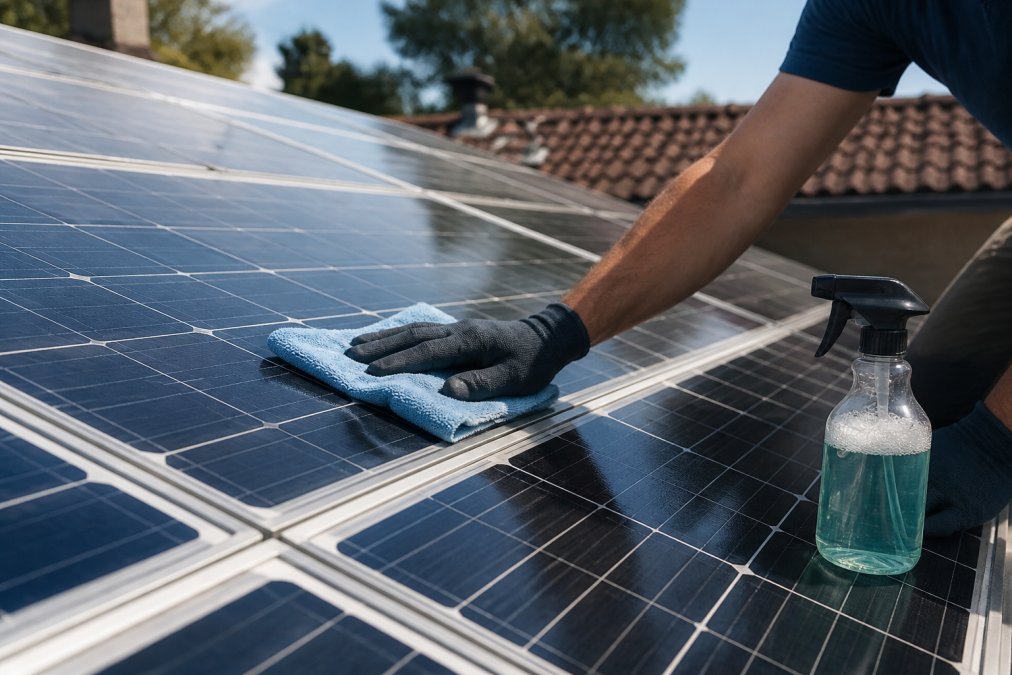
A 1:8 ratio of white vinegar to water is the cheapest eco friendly solar panel cleaner you can mix at home, and it handles light dust.
Pros and Cons
What works: extremely affordable and made from ingredients you already have. What doesn't: it requires manual mixing and application, and vinegar can leave streaks if you don't rinse thoroughly. It also won't touch baked-on bird droppings.
Pricing and Who It's For
Under $5 per batch. Best for homeowners with light dirt who want a chemical-free stopgap between professional cleanings.
BASF Solar Cleaning Chemicals: Best for Commercial Arrays
This is the option property managers reach for with large-scale arrays and performance reporting; the formulation targets long-term panel health rather than quick shine.
Pros and Cons
What works: industry-standard performance engineered for long-term panel health. What doesn't: it's primarily targeted at commercial users and isn't always available in small retail quantities, so a single homeowner may struggle to buy it.
Pricing and Who It's For
Contact BASF for pricing. Best for large-scale installations and professional cleaning services managing multiple sites.
Water-Fed Pole System: Best for Safe Ground-Level Cleaning
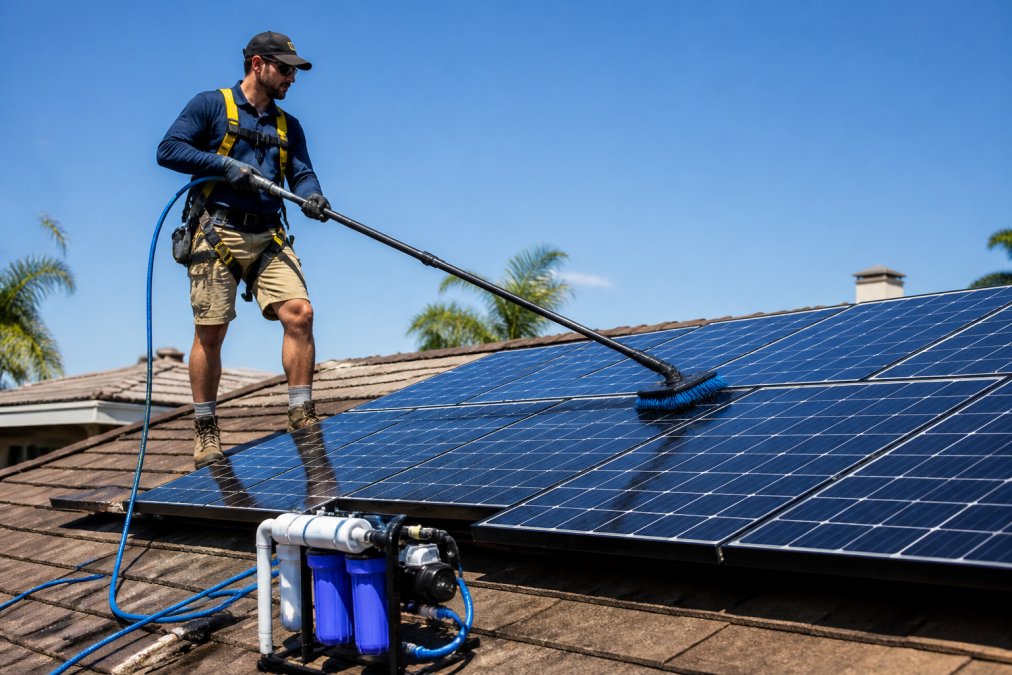
A water-fed pole lets you clean rooftop panels from the ground, removing the biggest risk in DIY solar maintenance: falling off your roof.
Pros and Cons
What works: eliminates the need for ladders and holds up to repeated use. What doesn't: it requires an upfront equipment investment and physical effort to operate, especially on a tall two-story roof.
Pricing and Who It's For
Starting around $100. Best for homeowners who want to clean their own panels safely from the ground without hiring help.
DI Water Filtration System: Best for Hard Water Areas
If your tap water is hard, a deionized water filtration system is the difference between a streak-free finish and a chalky film that bakes onto your glass. Water hardness is regional, and the right filter depends on what's dissolved in your local supply.
Why hardness varies so much by region
Water hardness is measured in grains per gallon (gpg) or milligrams per liter as calcium carbonate. Supplies fed by limestone and gypsum aquifers, common in the Southwest, Great Plains, and Midwest, run hard to very hard, while surface-water systems in the Northeast and Pacific Northwest tend to be softer.
What deionization actually removes
A DI resin bed exchanges dissolved mineral ions, calcium, magnesium, and others, for hydrogen and hydroxide ions, which recombine into pure water. With essentially no dissolved solids, it evaporates leaving nothing behind: the entire mechanism behind a spot-free dry. It differs from a carbon filter, which removes chlorine and organics but not hardness minerals, and from a softener, which swaps calcium for sodium and still leaves spotting solids.
DIY versus professional: the cost math
A residential DI filtration setup typically starts around $150, and the resin or cartridge is a consumable, replacement frequency depends on water hardness and gallons used. Cleaning a small array two or three times a year, the equipment can pay for itself within a couple of seasons versus service calls.
Pros and Cons
What works: no chemical runoff, professional-grade results, and a spot-free dry tap water can't match in hard-water regions. What doesn't: cartridges and resin need periodic replacement, upfront cost is higher than soap, and it only makes sense if you're committed to cleaning your own panels.
Pricing and Who It's For
Starting around $150 for a residential unit, plus ongoing resin or cartridge costs. Best for users in hard water areas who want a streak-free finish without a service call, and who have a small, safely accessible array.
pH-Neutral Solar Cleaning Soap: Best for Stubborn Grime
Specialized pH-neutral soap sits near 7 on the pH scale so it lifts grime without attacking the two things that cost money to replace: the glass surface and its bonded anti-reflective coating.
What to look for on the label
- pH between 6 and 8. Anything marketed as "heavy-duty" or "industrial strength" usually sits outside that window.
- Biodegradable surfactants. Plant-derived surfactants break down in soil and runoff; some petroleum-derived ones persist.
- No ammonia, no phosphates, no abrasives. Ammonia attacks coatings, phosphates feed algae in runoff, and abrasives scratch glass.
- Zero-residue or no-rinse formulation. Residue left behind becomes a magnet for dust, which restarts the soiling cycle faster.
The dilution trap
Most concentrated solar soaps are meant to be diluted, often between 1:10 and 1:100 depending on water hardness and grime. Over-concentrating is the most common DIY mistake: a too-strong solution leaves a sticky film that dries into a haze and wastes product. Under-concentrating means scrubbing longer, increasing abrasive contact.
Pros and Cons
What works: safe for sensitive panel coatings, effective on bird droppings and pollen film plain water leaves behind, and a zero-residue formula prevents soap scum buildup. What doesn't: it needs thorough rinsing unless it's a no-rinse formula, and it's solar-specific, so you can't repurpose it around the house.
Pricing and Who It's For
Concentrates typically start around $20 and dilute into many gallons, so cost per cleaning is usually a few dollars. Best for stubborn grime plain water leaves behind, and for owners avoiding the slow coating degradation harsh household cleaners cause.
Frequently Asked Questions
What is the best thing to use to clean solar panels?
The best cleaner for solar panels is deionized (DI) water, often applied with a soft-bristle brush or water-fed pole. DI water removes dirt without leaving mineral deposits or residue. If you need extra cleaning power for stubborn grime, use a pH-neutral, biodegradable soap specifically made for solar glass. Avoid abrasive tools and harsh chemicals that can damage the anti-reflective coating. For hard water areas, a DI filtration system is essential to prevent spotting.
Is Dawn dish soap safe to clean solar panels?
No, Dawn and other household dish soaps are not recommended for solar panels. They can leave a filmy residue that reduces light transmission and may contain surfactants or fragrances that degrade the anti-reflective coating over time. Even if rinsed thoroughly, soap scum can build up and attract more dirt. Stick to pH-neutral solar-specific cleaners or plain deionized water for safe, streak-free results.
How often should you clean solar panels to maintain efficiency?
Most homes need solar panel cleaning every 6 to 12 months. In dusty or high-pollen areas, or if you notice a drop in energy production, clean every 3 to 4 months. If you live near the coast, salt spray can accumulate faster, so a quarterly check is wise. Monitoring your solar output helps you decide. Professional services can assess soiling loss and recommend a schedule based on your location and roof pitch.
Are eco-friendly cleaners as effective as industrial chemicals for solar panels?
Yes, eco-friendly cleaners like DI water and pH-neutral soaps are just as effective for routine maintenance. They remove dust, pollen, and bird droppings without harming the glass or coatings. Industrial chemicals may be needed for heavy industrial soiling, but for residential systems, eco-friendly options prevent damage and avoid toxic runoff. Many professional services use only DI water and achieve streak-free, residue-free results.
What should you not clean solar panels with?
Avoid abrasive sponges, hard-bristle brushes, and scouring pads that can scratch the glass. Never use ammonia-based cleaners like Windex, acidic solutions (vinegar is okay in mild dilution but not recommended for regular use), or alkaline detergents. These can degrade the anti-reflective coating, cause micro-abrasions, and leave streaks. Also, don't use a pressure washer directly on panels, as high pressure can force water into seals and cause damage.
Dirty panels quietly drain the savings you bought your system for, and the wrong cleaner can scratch the glass or leave mineral film that's worse than the dust you started with. Elite Solar Cleaning Pros removes that risk with eco-friendly DI water cleaning, licensed and insured technicians, and a process that can restore up to 30% of your energy output. Get a free quote from Elite Solar Cleaning Pros and protect your solar investment with a cleaning that leaves nothing behind but results.