 ultimate-guide
Why Solar Panels Need Professional Cleaning
Table of Contents
- How Soiling Loss Affects Your Solar Panel Energy Output
- Risks of DIY Solar Panel Cleaning
- Solar Panel Warranty Requirements and Professional Maintenance
- Best Way to Clean Solar Panels Safely
- Solar Panel Cleaning Frequency and Preventative Maintenance
- When Professional Cleaning Becomes Essential
- Professional Cleaning Protects Your Solar Investment
- Frequently Asked Questions
Last Updated: September 27, 2026
How Soiling Loss Affects Your Solar Panel Energy Output
Dirt, dust, pollen, and environmental contaminants don't just look bad on solar panels, they directly reduce the energy your system produces. This phenomenon is called soiling loss, and it's one of the most underestimated threats to your solar investment's performance.
When debris accumulates on panel surfaces, it blocks sunlight from reaching the photovoltaic cells beneath. The result is measurable energy output decline. Depending on your climate and environmental conditions, soiling loss can reduce efficiency by anywhere from a few percentage points to substantially more over time. In arid regions with dust storms or coastal areas with salt spray, the impact accelerates. Even in cleaner climates, pollen accumulation and bird droppings create localized hot spots that degrade performance.
The key insight most homeowners miss: your panels may look acceptably clean to the naked eye while still losing significant energy production. Light dust films, mineral deposits from hard water, and microscopic contaminants are invisible at ground level but measurably reduce output. This is why regular inspection matters, and why professional assessment becomes essential when performance monitoring shows unexplained drops.
Risks of DIY Solar Panel Cleaning
The impulse to clean your own panels is understandable, it seems straightforward and saves money upfront. But DIY cleaning introduces multiple risks that can cost far more than professional service, both in immediate damage and long-term system degradation.
Micro-Cracking and Structural Damage
Solar panels are engineered to withstand weather, but they're not built for the mechanical stress of improper cleaning. Using abrasive brushes, pressure washers, or the wrong tools creates microscopic cracks in the panel's surface that expand over time. These micro-cracks compromise the structural integrity of the photovoltaic cells and the protective glass layer.
The damage isn't always visible immediately. A panel with micro-cracking may perform normally for weeks or months before performance degrades noticeably. By then, the damage is permanent. Water infiltration accelerates through these cracks, leading to internal corrosion of electrical components and junction boxes. The panel's lifespan shortens significantly, and the degradation compounds over time.
Hard water and mineral-heavy tap water also cause problems during DIY cleaning. When water evaporates on panel surfaces, mineral deposits remain behind, creating a new layer of soiling that's harder to remove than the original dirt. This requires more aggressive cleaning attempts, which increases the risk of micro-cracking further.
Warranty Voiding and Liability
Most solar panel manufacturers include specific cleaning requirements in their warranty terms. These warranties typically require professional cleaning with approved methods and materials, specifically deionized water systems and non-abrasive tools. DIY cleaning, especially with pressure washers or abrasive methods, violates these conditions.
Voiding your warranty is a silent financial catastrophe. If a panel fails after DIY cleaning attempts, the manufacturer won't cover replacement or repair costs. A single failed panel in a residential system can cost hundreds to thousands of dollars out of pocket, completely erasing any savings from the DIY approach.
Beyond warranty concerns, liability exposure increases significantly. If a DIY cleaning attempt damages your roof, electrical connections, or causes personal injury, your homeowner's insurance may not cover the damage if you performed the work yourself without proper licensing and insurance. Professional solar panel cleaning companies carry liability insurance specifically for this work, you don't.
Solar Panel Warranty Requirements and Professional Maintenance
Your solar panel warranty is only as good as your adherence to its maintenance terms. Understanding what manufacturers require is essential to protecting your investment.
Most manufacturers specify that panels must be cleaned using deionized water systems and soft, non-abrasive materials. They often require that cleaning be performed by certified professionals who follow industry best practices. Some warranties explicitly state that damage from improper cleaning voids coverage entirely, not just for that repair, but potentially for the entire system.
Professional solar panel cleaning companies maintain certifications and training specifically to meet these warranty requirements. They use approved equipment, track service records, and provide documentation that demonstrates compliance. This documentation protects you if a warranty claim becomes necessary.
The maintenance schedule outlined in your warranty typically recommends annual or semi-annual inspections and cleaning depending on your regional climate. Coastal areas with salt spray may require more frequent service. Desert regions with dust storms benefit from cleaning after major weather events. Professional services tailor their schedules to your specific conditions and warranty terms.
Best Way to Clean Solar Panels Safely
Professional solar panel cleaning uses methods specifically designed to remove soiling without damaging panels or creating liability.
Deionized Water and Non-Abrasive Tools
The gold standard for professional cleaning is deionized water, water stripped of minerals and ions through purification systems. When this water is applied to panel surfaces, it doesn't leave mineral deposits as it evaporates. The water itself becomes the cleaning agent, combined with soft, non-abrasive brushes or water-fed poles.
Deionized water systems use reverse osmosis or ion exchange to remove dissolved minerals that standard tap water contains. This matters because hard water leaves residue that requires more aggressive scrubbing to remove, which increases the risk of micro-cracking. Deionized water eliminates this problem entirely.
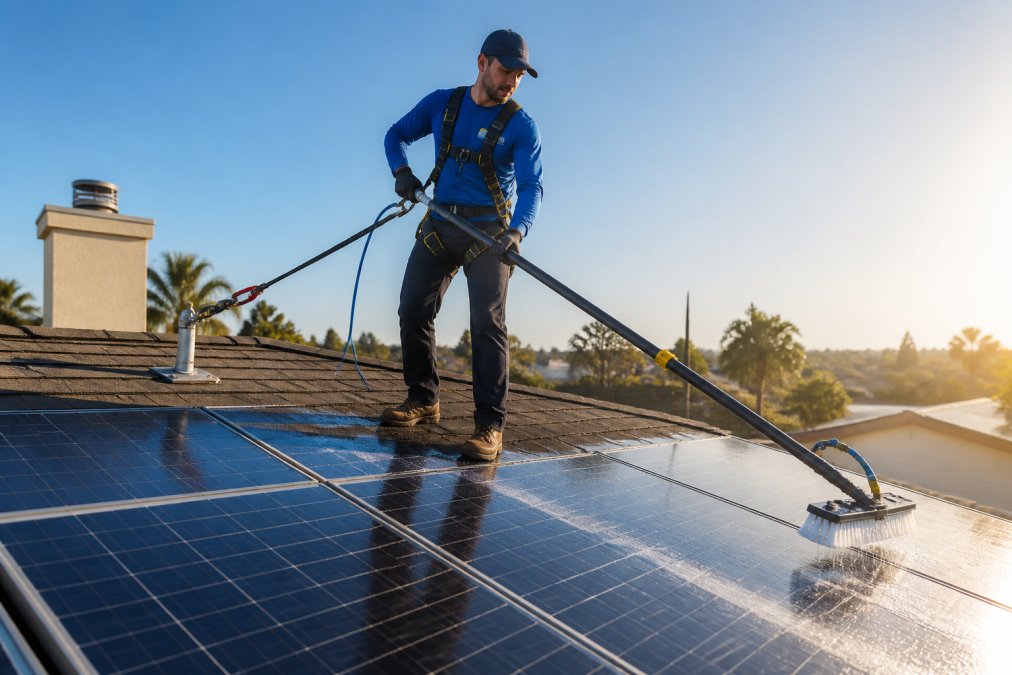
Non-abrasive tools include soft-bristled brushes, microfiber cloths, and water-fed poles with gentle spray patterns. These tools remove debris and contaminants without creating surface stress on the panel glass. Professional technicians are trained to apply appropriate pressure, enough to clean effectively, never so much that it risks damage.
Safety Protocols and Roof Access
Roof work carries inherent risks. Professional cleaning services implement multiple safety layers that DIY attempts cannot replicate. Technicians use fall protection equipment, including safety harnesses, lanyards, and roof anchors, to prevent falls from height. They're trained in proper roof navigation, weight distribution, and awareness of electrical hazards near the panels and roof edges.
Electrical safety is critical.
Solar Panel Cleaning Frequency and Preventative Maintenance
How often your panels need cleaning depends on your climate, surrounding environment, and system performance monitoring.
| Cleaning Factor | Frequency | Best Timing | Impact on Efficiency |
|---|---|---|---|
| Standard residential area | Annual | Spring or early fall | 5-15% recovery |
| Coastal salt spray | Quarterly to semi-annual | After storm events | 10-25% recovery |
| Desert dust environment | After major storms + annual | Post-dust season | 15-30% recovery |
| Urban pollution | Semi-annual | Spring and fall | 8-12% recovery |
When Professional Cleaning Becomes Essential
Certain conditions make professional cleaning not just beneficial, but necessary to protect your system and warranty.
Environmental Contaminants and Regional Climate Factors
Salt spray in coastal areas creates corrosive deposits that accelerate panel degradation beyond simple soiling. These mineral-heavy contaminants require specialized cleaning knowledge to remove without damaging protective coatings. Professional services understand regional environmental challenges and adjust their methods accordingly.
Visual Inspection Checklist
Before committing to professional cleaning, perform a visual inspection to assess your system's condition:
- Check for visible dust, dirt, or debris accumulation on panel surfaces
- Look for bird droppings, pollen clumps, or organic matter
- Inspect for water stains or mineral deposits (white or brown streaks)
- Note any discoloration or dark spots on panel surfaces
- Check for visible cracks, chips, or damage to panel glass
- Examine mounting hardware for corrosion or looseness
- Review inverter display for performance warnings or error codes
- Compare current energy output to historical baseline for your system
- Note any unusual temperature variations across panels (thermal imaging)
Professional Cleaning Protects Your Solar Investment
Your solar panels represent a significant financial investment designed to generate savings for decades. Professional cleaning isn't an expense, it's protection for that investment.
Frequently Asked Questions
Is professional solar panel cleaning really worth the investment?
Yes, professional solar panel cleaning directly impacts energy output and system longevity. Soiling loss from dust, pollen, bird droppings, and environmental contaminants can reduce efficiency significantly. Professional cleaning using deionized water and non-abrasive tools restores photovoltaic efficiency without risking micro-cracking or warranty voiding. The energy yield improvement typically justifies the service cost, especially in areas with high dust or salt spray exposure. Professional certification and insurance also protect your investment if damage occurs.
What are the main risks of DIY solar panel cleaning?
DIY cleaning risks include micro-cracking from abrasive brushes or pressure washers, electrical hazards when accessing junction boxes and inverters, falls from roof access without proper safety equipment, and hard water buildup from tap water use. Most critically, DIY cleaning can void your solar panel warranty if the manufacturer determines improper maintenance caused damage. Professional cleaners use purified water systems and follow manufacturer guidelines to avoid these pitfalls entirely.
How often should solar panels be professionally cleaned?
Cleaning frequency depends on your regional climate and environmental factors. Coastal areas with salt spray may need quarterly cleaning, while arid regions with dust accumulation typically need semi-annual service. Monitor your system performance through your inverter health readings and thermal imaging inspections. Annual maintenance inspections help identify when cleaning is needed. Professional providers can recommend a schedule based on your specific location and panel degradation patterns.
Can pressure washers damage solar panels?
Yes, pressure washers are a leading cause of micro-cracking and panel failure. High-pressure water can damage the protective glass surface and force water into electrical components, creating safety hazards and voiding warranties. The best way to clean solar panels safely uses low-pressure deionized water systems with non-abrasive tools. Professional-grade equipment is designed specifically to remove debris without structural damage while protecting your system's ROI and longevity.