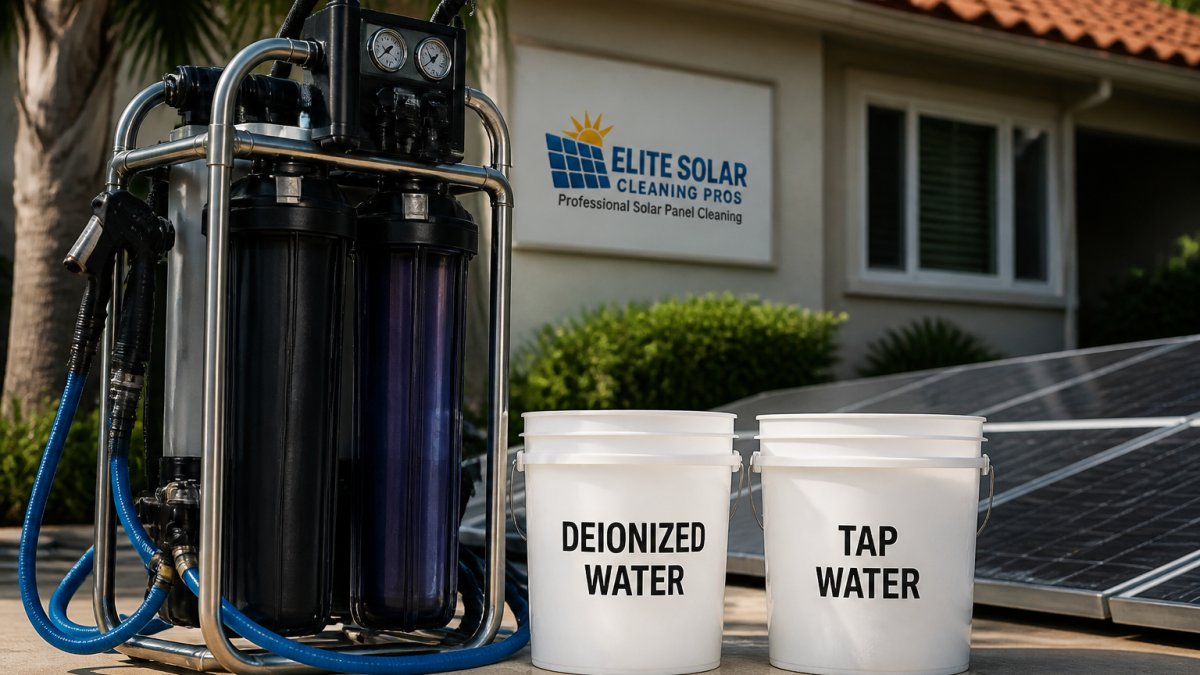
 comparison
Deionized Water vs Tap Water for Solar Panel Cleaning
Table of Contents
- What Tap Water Leaves Behind on Solar Panels
- How Deionized Water Cleaning Works
- Benefits of Deionized Water for Solar Panel Performance
- Solar Panel Water Spot Removal: Why Tap Water Fails
- How to Clean Solar Panels Safely With DI Water
- DIY Deionization Systems vs Professional Cleaning
- Frequently Asked Questions
Last Updated: October 2, 2026
What Tap Water Leaves Behind on Solar Panels
Tap water is not pure water. It carries dissolved minerals picked up as it travels through groundwater and surface water systems, and when that water evaporates off a hot solar panel, those minerals stay behind.
That residue is the single biggest reason panels look worse after a rinse than they did before. According to the U.S. Environmental Protection Agency's drinking water standards, municipal water is treated for safety, not for purity, so calcium, magnesium, silica, and other mineral ions remain in the supply.
Total Dissolved Solids and Mineral Ions
Total dissolved solids (TDS) is the combined concentration of all dissolved minerals, salts, and metals in a water sample, measured in parts per million. The higher the TDS, the more material is left on a surface after the water dries.
| Water Source | Typical TDS Level | Residue Risk on Panels |
|---|---|---|
| Untreated tap water | High | Severe spotting and scale |
| Softened tap water | Moderate | Reduced spots, still leaves film |
| Reverse osmosis filtered | Low | Minimal residue |
| Deionized water | Near zero | No spots, spot-free rinse |
How Deionized Water Cleaning Works
Deionized water cleaning passes tap water through ion exchange resin, a bed of electrically charged beads that swap mineral ions for hydrogen and hydroxide. The result is water with almost no dissolved solids, so it dries without leaving anything behind.
Ion Exchange Resin and TDS Thresholds
Resin has a finite deionization capacity. Once the exchange sites fill up, the water passing through starts carrying minerals again, and the system needs a resin change.
Benefits of Deionized Water for Solar Panel Performance
Deionized water protects output because it protects the glass. A clean panel transmits more sunlight, and a spotted panel scatters it.
The benefits stack up quickly:
- No water spots or scale, so light transmission stays at its peak
- No chemical residue, which matters for chemical purity and for the warranty on coated glass
- Spot-free rinse, meaning no hand-drying and no contact with the surface
- No mineral buildup that would otherwise harden into permanent etching
- Safe for coatings, since deionized water is free of the organic compounds and particulates that abrasives introduce
Solar Panel Water Spot Removal: Why Tap Water Fails
Solar panel water spot removal with tap water is a losing battle because the water itself is the source of the spots. You cannot rinse away minerals with water that contains minerals. But the failure is not uniform, it depends on your water's TDS reading and the surface you are cleaning, and that is where most guides stop short.
TDS Thresholds That Decide Whether You Get Spots
Total dissolved solids is the single number that predicts whether a rinse will spot. Most practitioners use these working thresholds:
| TDS Reading | What It Means for Cleaning |
|---|---|
| 0-10 ppm | Spot-free rinse; no drying needed on glass |
| 10-50 ppm | Light spotting on glass; acceptable for concrete and siding |
| 50-150 ppm | Visible film on glass and coated surfaces |
| 150+ ppm | Heavy scale risk; not suitable for a final rinse |
Why the Damage Is Not Just Cosmetic
Fresh mineral deposits sit on top of the glass and wipe off. Under repeated sun exposure, calcium carbonate and silica can bond chemically to the glass surface and etch microscopic pits into it. Once that happens, no amount of scrubbing restores the clarity. Water hardness and scale formation turn a five-minute rinse into a permanent optical defect.
Surface-by-Surface: Where Tap Water Fails Worst
The spotting problem is not limited to panels. The same chemistry plays out differently across surfaces:
- Glass (panels, windows, shower doors): The worst offender. Dissolved silica and calcium bond to glass and etch it under heat. Tap water leaves a haze that builds with every rinse.
- Electronics and circuit boards: Tap water's mineral ions and trace salts conduct electricity and leave corrosive residue. Deionized water is the standard for precision electronics cleaning because it dries without leaving conductive deposits.
- Automotive paint and chrome: Tap water spots etch clear coat and leave mineral rings on chrome. Detailers use a final deionized rinse specifically to avoid hand-drying and swirl marks.
- Stainless steel and appliances: Tap water leaves streaks and can contribute to surface corrosion over time; DI water dries clean.
- Concrete, siding, and pavers: The least sensitive surface. Tap water is usually fine here because spotting is not visible and does not affect performance.
How to Clean Solar Panels Safely With DI Water
Cleaning solar panels safely with deionized water takes about 30 minutes for a typical residential array. The method is gentle by design: no pressure washers, no abrasive pads, no harsh soaps.
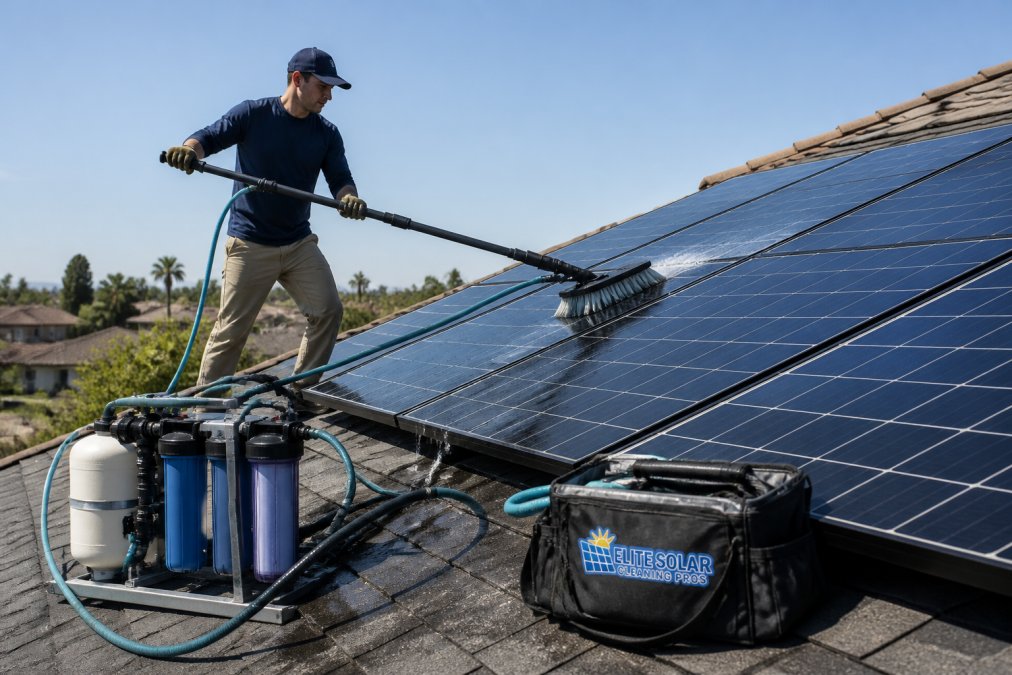
Follow this sequence:
- Shut down if your inverter manual requires it, and never work on a wet roof.
- Rinse loose dust first with deionized water to avoid grinding grit into the glass.
- Wash with a soft-bristle brush on a water-fed pole, working top to bottom.
- Rinse again with DI water and let it air dry. No towel, no squeegee.
- Check the TDS meter before and after to confirm the resin is still active.
DIY Deionization Systems vs Professional Cleaning
DIY deionization systems work well for a single-story array and a homeowner who enjoys the work. For multi-story roofs, steep pitches, or commercial arrays, professional cleaning is the safer and more reliable choice. The real question most guides skip is the math: does a home DI setup actually pay for itself compared with buying bottled deionized water or hiring a service?
The ROI of a Home DI System vs. Bottled Water
Bottled deionized water is convenient but expensive per gallon, and it is impractical for rinsing a full array, you would need dozens of gallons per cleaning. A portable DI cart or resin tank lets you produce spot-free water at home for a fraction of the per-gallon cost, with the trade-off being the upfront purchase and periodic resin replacement.
DIY Options Compared
| Option | Typical Cost | Best For | Trade-Off |
|---|---|---|---|
| Portable DI cart | $300-$600 | Single-story arrays, cars, RVs | Resin cartridges need frequent replacement |
| Reverse osmosis pre-filter | $400-$600 | Lowering TDS before a final DI stage | Requires under-sink installation |
| Whole-home softener | $600-$1,200 | General cleaning water quality | Does not remove all TDS |
| Bottled deionized water | Per-gallon cost adds up fast | Small jobs, spot treatments | Impractical for full-array rinses |
| Professional DI service | Quote-based | Two-story roofs, commercial arrays, HOA properties | Ongoing service cost |
A whole-home softener reduces hardness but does not deliver the spot-free finish a dedicated DI system produces, so it is a supporting step rather than a substitute. Reverse osmosis extends resin life by pre-treating the water, which is why detailers pair it with a final deionization stage.
When Professional Cleaning Wins
Professional cleaning makes more sense when safety, insurance, and consistency matter. A licensed and insured provider works with HOA approval processes and uses a DI method that reaches panels from the ground with water-fed poles, so nobody walks on your roof. For property managers and HOA boards tracking performance across a community array, consistency is important.
Frequently Asked Questions
Why does tap water leave spots on solar panels?
Tap water contains dissolved minerals like calcium and magnesium, measured as total dissolved solids. When water evaporates from a hot panel surface, these mineral ions stay behind and form white spots. Over time, repeated spotting creates a dull film that blocks sunlight and reduces energy production. Deionized water cleaning removes these minerals before they can leave residue.
Is deionized water better than tap water for cleaning glass?
Yes, for streak-free results. Deionized water has had its mineral ions removed through ion exchange resin, leaving near-zero TDS. When it dries, nothing remains on the glass. Tap water, even in areas with relatively soft water, still carries enough dissolved solids to leave visible spotting on dark solar panel surfaces.
Can tap water cause mineral buildup on solar panels?
Repeated washing with hard tap water causes scale formation, a crusty mineral layer that bonds to the glass. This buildup is harder to remove than fresh spots and can require specialty cleaning products. Inconsistent tap water quality, especially from groundwater sources, makes the problem unpredictable.
Does using tap water void solar panel warranties?
Many manufacturers specify that panels should be cleaned with water and a soft brush, but hard water minerals that etch or scratch the glass may fall outside warranty coverage. Check your specific warranty terms. Using deionized water cleaning methods eliminates that risk because it leaves no abrasive mineral residue behind.
Cleaning solar panels with the wrong water is worse than not cleaning them at all, because you trade dust for etched glass. If you want your array restored to peak output without the risk of a rooftop fall or a scratched panel, Elite Solar Cleaning Pros delivers eco-friendly DI water cleaning, licensed and insured crews, and a spot-free finish that protects your investment. Get started with Elite Solar Cleaning Pros and see your energy output climb back toward where it should be.